AC Capacitor Replacement Cost
Short answer
AC capacitor replacement cost is mostly labor: a round dual run capacitor listed for $8.96 to $19.21 as a part on October 27, 2026, so the service call is what you pay for.
Penny Damper bench notes · updated
Partner links on this page go to PlumbingSupplyAndMore, under the same ownership as Penny Damper. They are there for price reference and examples; no figure here depends on them. How partner links work
Jump to a section
Shop notes
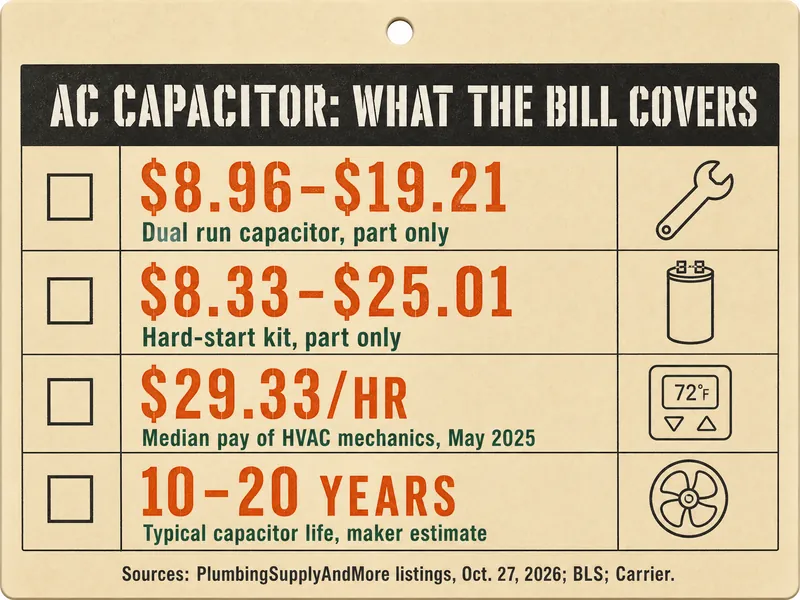
- A round 440-volt dual run capacitor, 25/5 to 80/5 µF, was listed at $8.96 to $19.21 at PlumbingSupplyAndMore on October 27, 2026 (part only).
- Hard-start kits listed for $8.33 to $25.01 that day, also part only; a technician decides whether one belongs on your unit.
- Carrier says capacitors "store lethal amounts of energy even when the power is off," so the swap is a licensed technician's job.
- The Bureau of Labor Statistics puts HVAC mechanics' median pay at $29.33 an hour, or $61,010 a year (May 2025); a company's rate sits above that.
- Carrier estimates most AC capacitors last 10 to 20 years; Lennox says "around 20 years," with heat and weather shortening it.
- Humming without starting, warm air and short cycling are the signs both makers list.
How much does an AC capacitor replacement cost?
The part is cheap and the visit is not. A round dual run capacitor rated 440 volts, from 25/5 µF up to 80/5 µF, was listed at $8.96 to $19.21 on October 27, 2026, at a supply house that shares owners with Penny Damper (capacitor listings). That is part only. Everything else on the invoice is the technician's time and what it costs a company to put that person in your driveway.
Penny Damper never prints a total for this job, because the total is set by your local labor rate, not by the part. What the labor line pays for is easier to pin down: the trip, the diagnosis (a capacitor that tests weak is only one cause of a unit that hums), the safe discharge and swap, a check of the contactor and wiring, and a test run. A company's hourly rate also has to cover its vehicle, insurance, meters and tools, and the hours nobody bills for.
For a yardstick on the people doing the work, BLS lists the median wage for heating, air conditioning and refrigeration mechanics at $29.33 an hour in May 2025. Ask for the diagnosis and an itemized quote in writing before work starts, with the part's microfarad and voltage rating on it. If the quote says the compressor is failing too, read what a compressor replacement involves before you agree to anything.
| Line on the invoice | What it is | Figure you can check |
|---|---|---|
| Dual run capacitor | Round 440 V part, 25/5 to 80/5 µF | $8.96–$19.21, part only |
| Hard-start kit (if fitted) | Extra start boost for a compressor | $8.33–$25.01, part only |
| Labor and trip | Diagnosis, discharge, swap, test run | Local rate; BLS median pay $29.33/hr |
| Contactor or wiring (if found) | Parts beside the capacitor that also wear | Ask for the part name and price |
What does a capacitor do?
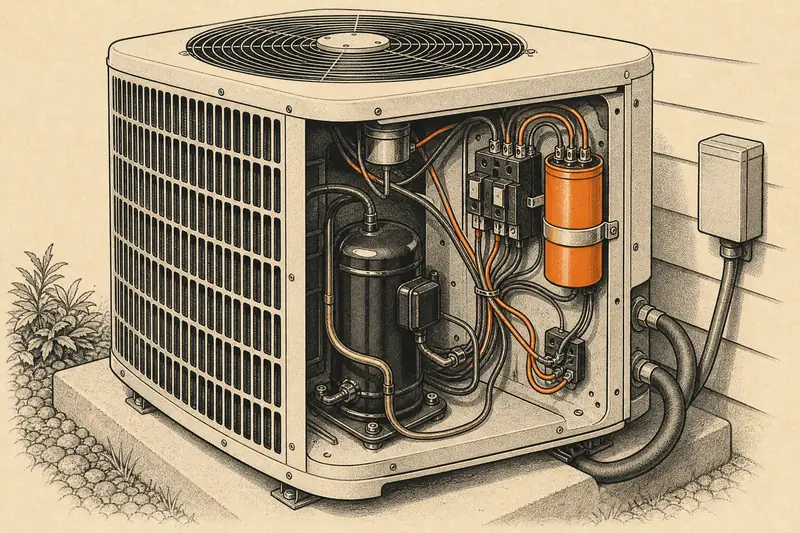
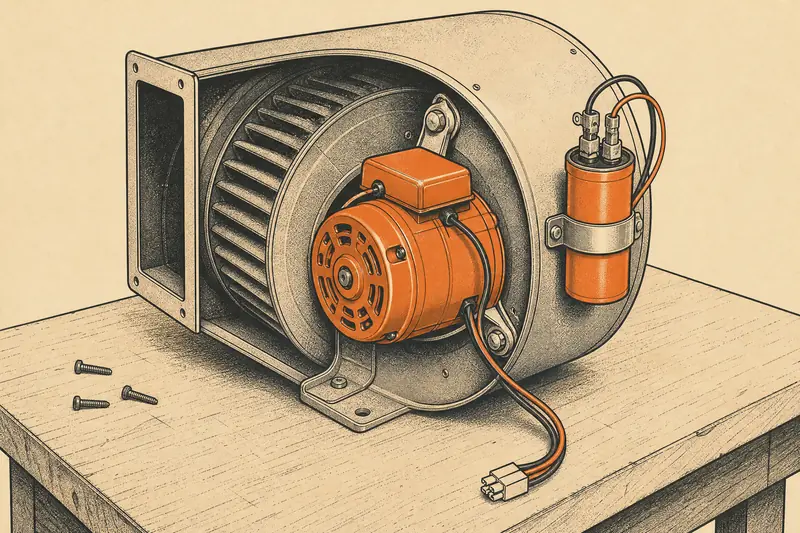
A capacitor stores a charge and releases it to start and steady the motors in the outdoor unit. Carrier describes it as a part that gives "the high-voltage jolt needed to start your AC motors" and then keeps their power steady. Lennox says most AC capacitors fall between 5 and 80 microfarads, and they are rated by both voltage and microfarads.
Most central air conditioners use a dual run capacitor: one can with three terminals that serves the compressor and the outdoor fan motor at the same time. The label shows two numbers, such as 40/5, for the compressor side and the fan side. A replacement has to match that rating; Carrier warns that the wrong microfarad or voltage rating can damage the system or void a warranty.
How do you tell a capacitor is failing?
The common signs are a humming outdoor unit that never starts, warm air from the vents, and a system that turns on and off rapidly. Carrier lists all three, and adds that a bad capacitor may look swollen or be leaking oil. Lennox adds clicking and a creeping rise in the electric bill, because motors that start badly draw more current.
You can spot most of this without opening anything. Stand near the outdoor unit when the thermostat calls for cooling and listen: a steady hum with the fan still, or a fan that only spins when nudged, points toward the capacitor. Don't poke a stick or anything else through the fan grille to test it. Check the cheaper causes first in the AC not cooling checklist: thermostat set to Cool, breaker on, a clean filter.
Don't keep running a unit that hums and won't start. Carrier says running an air conditioner with a bad capacitor can permanently damage the compressor and fan motors, and that a capacitor costs far less than a compressor. Shut it off at the thermostat and get a diagnosis.
Is replacing a capacitor a DIY job?
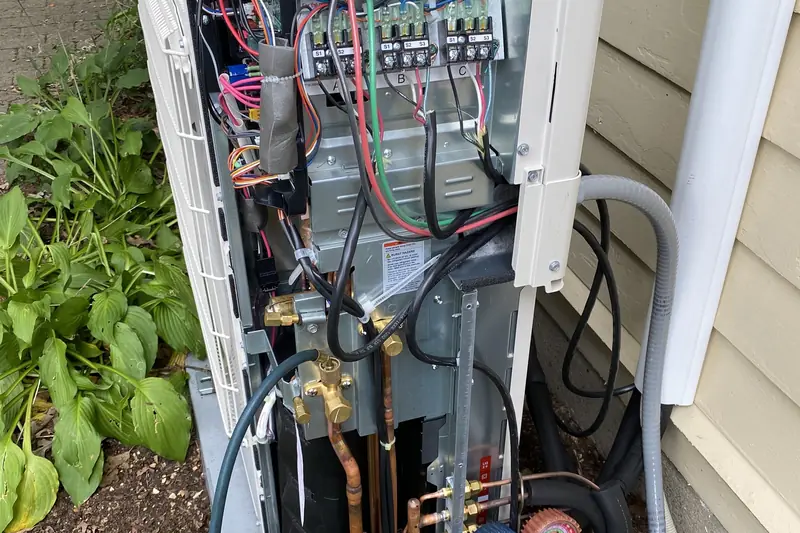
No. Capacitors hold a charge even after the breaker and the outdoor disconnect are off, and that stored charge can injure or kill. Carrier says this repair "should typically be handled by a qualified HVAC professional," and Lennox says that because capacitors hold a charge, "replacement requires professional handling." Penny Damper does not explain discharging, testing or wiring a capacitor.
Your safe jobs stop at the cabinet: the filter, the thermostat, the breaker (one reset only; a second trip means stop) and clearing leaves from around the outdoor unit with power off. The safe upkeep list covers them. If you're unsure, call a licensed technician.
Capacitor numbers
- $8.96–$19.21Round dual run capacitor, 25/5 to 80/5 µF, part only, Oct. 27, 2026PlumbingSupplyAndMore (under the same ownership as Penny Damper) (PlumbingSupplyAndMore, under the same ownership as Penny Damper)
- $8.33–$25.01Hard-start kit (start capacitor plus relay), Oct. 27, 2026 listingPlumbingSupplyAndMore (under the same ownership as Penny Damper) (PlumbingSupplyAndMore, under the same ownership as Penny Damper)
- $29.33HVAC mechanics' median wage per hour, May 2025BLS
- 10–20 yearsTypical AC capacitor life, maker estimateCarrier
- 5–80 µFRange most AC capacitors fall inLennox
What is a hard-start kit and does it help?
A hard-start kit is a start capacitor with a relay that gives a compressor an extra push at startup, then drops out of the circuit. Supply houses list them by torque boost and voltage range; on October 27, 2026 the kits on the same supply house's hard-start kit page (PlumbingSupplyAndMore, under the same ownership as Penny Damper) ran $8.33 to $25.01, part only.
It helps only when the problem is a hard start. A Goodman service bulletin on hard-start kits (2005) names low voltage, slow pressure equalization and a tight compressor as the usual causes, and warns that start assist "will not prevent compressor failure" on a low-voltage supply. The same bulletin says Goodman's own start kits do not void its warranties. Whether your unit needs one is a technician's call, made after the capacitor and voltage are checked.
How long do capacitors last?
Makers give a long range: Carrier says most AC capacitors last 10 to 20 years, and Lennox says around 20. Both say heat shortens that. Lennox notes capacitors are among the most frequently replaced parts in an air conditioner, and the hottest weeks are when they quit.
You can't add years to a capacitor yourself, but you can keep its surroundings cool. Carrier points to airflow around the outdoor unit; Lennox's AC homeowner manual asks you to check the outdoor unit monthly and clear anything that blocks airflow, with power off at the disconnect. A yearly professional check catches a capacitor drifting out of its rating before it strands you, and the repair-or-replace test helps if the unit is old enough that the capacitor is the least of its worries.
How these numbers were checked
This page is based on Carrier's and Lennox's capacitor guides, Lennox's AC homeowner manual, a 2005 Goodman service bulletin on hard-start kits and the Bureau of Labor Statistics Occupational Outlook Handbook (pay data for May 2025), all read in October 2026. Part prices are listed prices at PlumbingSupplyAndMore on October 27, 2026, part only. Total job prices, contractor price surveys and cost-guide figures are left out, and so are any steps for testing or discharging a capacitor.
More questions
Can a bad capacitor make the AC run but blow warm air?
Yes. Carrier says a weak capacitor may fail to bring the compressor up to speed, so the indoor fan runs while the air stays lukewarm. Other faults cause the same symptom, which is why a diagnosis comes before a part.
Should both sides of a dual capacitor be replaced together?
A dual run capacitor is one part, so replacing it replaces both sides at once. If your unit has two separate capacitors, Lennox says a technician may swap them for a single dual unit.
Does a bigger microfarad rating work better?
No. The replacement should match the rating on the original label or in the maker's specifications. Carrier warns that the wrong microfarad or voltage rating can damage the system or void the warranty.
Can I buy the capacitor myself and pay only for labor?
Ask before you buy. Some companies install customer-supplied parts and some won't warranty them, and the part still has to match the unit's rating exactly. Either way, the installation is a technician's job.
Is a swollen capacitor dangerous?
Treat it as a failed part that still may hold a charge. Leave the panel on, switch the system off at the thermostat, and have a licensed technician replace it.
Will a hard-start kit save a dying compressor?
Not in the long run. Goodman's bulletin says start assist will not prevent compressor failure on a low-voltage supply, and a tight compressor usually loosens up after a run-in period without one.
Does a new capacitor lower the electric bill?
It can if the old one was failing. Lennox says a struggling capacitor makes the unit draw more electricity than usual; a healthy one only restores normal running.
More on repair costs
Back to the Penny Damper front page