SEER2 Ratings and What They Save
Short answer
SEER2 ratings measure seasonal cooling output per watt-hour under DOE's 2023 test; the legal minimum is 13.4 to 14.3 depending on region and system type.
Penny Damper bench notes · updated
Jump to a section
Shop notes
- SEER2 is shown in Btu per watt-hour; the "2" marks DOE's test change that took effect Jan. 1, 2023 (DOE FEMP).
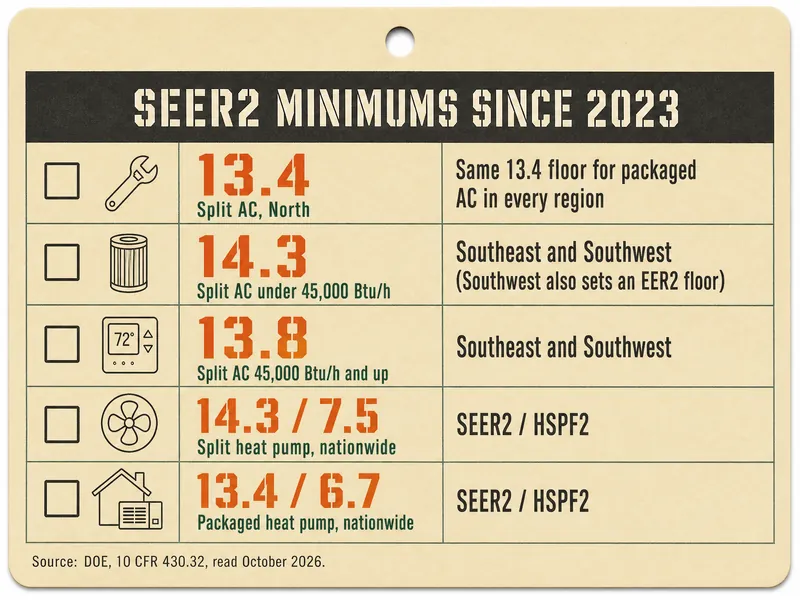
- Split air conditioners must reach 13.4 SEER2 in the North and 14.3 in the Southeast and Southwest (under 45,000 Btu/h), per 10 CFR 430.32.
- Split heat pumps have one national floor: 14.3 SEER2 and 7.5 HSPF2. Regional rules apply to air conditioners only.
- In DOE's Southeast example, a 15.2 SEER2 unit uses 1,085 kWh a year less than a 13.4 unit, about $197 at the August 2026 U.S. average of 18.16 cents per kWh (EIA).
- DOE's federal buyers' math says that Southeast upgrade pays off if it costs no more than $1,853 extra (2023 dollars, at 11 cents per kWh).
- Installation quality can swing efficiency by up to 30 percent (ENERGY STAR), more than the gap between many ratings.
What does SEER2 mean?
SEER2 is the Seasonal Energy Efficiency Ratio 2: the cooling an air conditioner or heat pump delivers over a typical season divided by the electricity it uses, shown in Btu per watt-hour. Higher is better. DOE's Federal Energy Management Program says that effective Jan. 1, 2023, the U.S. Department of Energy "changed the way HVAC systems are tested," and the new ratings are SEER2 for cooling and HSPF2 for heating, defined in 10 CFR 430 Appendix M1.
Because the test changed, an old SEER number and a new SEER2 number are not the same scale, and no DOE page we read gives an official conversion. Compare SEER2 to SEER2 only. When a quote lists a plain "SEER" figure for new equipment, ask for the SEER2 rating from the maker's spec sheet.
What are the SEER2 minimums by region?
The national floor is 13.4 SEER2 for central air conditioners made on or after Jan. 1, 2023, with higher floors for split systems installed in the Southeast and Southwest. The regional rules apply to where the unit is installed, and DOE enforces them at the outdoor unit: a model whose rated combination falls below the standard for a region "cannot be installed in that region."
| System | North | Southeast | Southwest |
|---|---|---|---|
| Split AC under 45,000 Btu/h | 13.4 SEER2 | 14.3 SEER2 | 14.3 SEER2 + 11.7 EER2 (9.8 if SEER2 is 15.2 or higher) |
| Split AC 45,000 Btu/h and up | 13.4 SEER2 | 13.8 SEER2 | 13.8 SEER2 + 11.2 EER2 (9.8 if SEER2 is 15.2 or higher) |
| Packaged AC | 13.4 SEER2 | 13.4 SEER2 | 13.4 SEER2 + 10.6 EER2 |
| Split heat pump | 14.3 SEER2 / 7.5 HSPF2 | Same (national) | Same (national) |
| Packaged heat pump | 13.4 SEER2 / 6.7 HSPF2 | Same (national) | Same (national) |
The Southeast in the rule covers Alabama, Arkansas, Delaware, Florida, Georgia, Hawaii, Kentucky, Louisiana, Maryland, Mississippi, North Carolina, Oklahoma, South Carolina, Tennessee, Texas, Virginia, the District of Columbia, Puerto Rico and the U.S. territories. The Southwest is Arizona, California, Nevada and New Mexico. Every other state follows the national numbers.
EER2 is a second cooling rating that DOE requires only in the Southwest. As of October 2026, the EPA rule effective July 27, 2026 lets leftover R-410A systems built before 2025 still be installed, but the outdoor unit still has to meet your region's minimum; see the R-410A change.
What is HSPF2?
HSPF2 is the Heating Seasonal Performance Factor 2, the heat pump's seasonal heating efficiency under the same 2023 test change; higher means less electricity per unit of heat. The minimum is 7.5 HSPF2 for a split heat pump and 6.7 for a packaged one, everywhere in the country. Gas furnaces are not covered by these numbers.
ENERGY STAR says a heat pump "can deliver up to three times more heat energy to a home than the electrical energy it consumes," and its cold-climate criteria test units down to 5°F. If you heat with a heat pump, HSPF2 matters as much as SEER2, and so do the settings: the heat pump settings page covers setbacks and backup heat.
SEER2 at a glance
- 13.4National SEER2 floor for central air conditioners since 202310 CFR 430.32
- 14.3SEER2 floor for split AC under 45,000 Btu/h in the Southeast and Southwest10 CFR 430.32
- 7.5HSPF2 floor for split heat pumps nationwide10 CFR 430.32
- 1,085 kWhYearly use cut from 13.4 to 15.2 SEER2 in DOE's Southeast exampleDOE FEMP
- 18.16¢Average U.S. residential electricity price per kWh, August 2026EIA
How much does a higher SEER2 save?
Going from 13.4 to 15.2 SEER2 cuts cooling electricity by about 12 percent for the same cooling, and the dollars depend on how many hours you run it. DOE's FEMP worked examples use a 3-ton (36,000 Btu/h) central AC and the hours its 2016 analysis assumed for each region. Penny Damper re-priced those kWh figures at the EIA August 2026 residential average of 18.16 cents per kWh; that arithmetic is ours.
| Region (hours per year in DOE's example) | 13.4 SEER2 | 15.2 SEER2 | 23.5 SEER2 | 13.4 to 15.2 saves |
|---|---|---|---|---|
| Southeast (3,409 hours) | 9,159 kWh, about $1,663 | 8,074 kWh, about $1,466 | 5,222 kWh, about $948 | about $197 a year |
| North (1,705 hours) | 4,581 kWh, about $832 | 4,038 kWh, about $733 | 2,612 kWh, about $474 | about $99 a year |
| Southwest (1,599 hours) | 4,296 kWh, about $780 | 3,787 kWh, about $688 | 2,450 kWh, about $445 | about $92 a year |
Your own numbers will differ with house size, insulation, duct leaks and the local rate. To scale the table, multiply the kWh saved by the price per kWh on your bill: 1,085 kWh × 18.16 cents ≈ $197. Raising the thermostat in summer and running a ceiling fan cut cooling hours too, for nothing; see thermostat settings.
Is a higher-efficiency system worth the price?
It is worth it when the extra cost is smaller than what the higher rating saves over the years you will own it. FEMP's calculation for federal buyers says an ENERGY STAR central AC in the Southeast saves money if it is priced no more than $1,853 (2023 dollars) above the less efficient model; in the North the figure is $927 and in the Southwest $869. Those use an 11-cent federal electricity price, so at today's higher residential average the break-even is larger.
A simple payback test works on any two quotes: divide the price difference by the yearly savings for your region. In the North each $99 of extra price takes about a year to earn back; in the Southeast each $197 does.
Installation can matter more than the label. ENERGY STAR says improper installation "can reduce system efficiency by up to 30 percent," and a wrong refrigerant charge or leaky ducts eat into the rating; ask how the contractor will size the system and test the charge and airflow. ENERGY STAR also says sealing and insulating ducts can improve efficiency by as much as 20 percent; see duct leaks. Refrigerant work is for an EPA-certified technician only. If you're unsure, call a licensed technician.
The 25C tax credit used to reward the top efficiency tier, but as of October 2026 it doesn't apply to equipment installed after Dec. 31, 2025; the tax credits page covers what is left. For the bigger decision, use the repair or replace test.
How these numbers were checked
Based on 10 CFR 430.32 (eCFR current text), DOE FEMP's purchasing guidance for residential central air conditioners (examples dated December 2024, prices in 2023 dollars), EIA Electric Power Monthly Table 5.6.A (August 2026 data, released Oct. 23, 2026), and ENERGY STAR's heat pump and heating and cooling pages, all read October 27, 2026. Dollar figures at 18.16 cents are Penny Damper's arithmetic on DOE's kWh. Left out: any SEER-to-SEER2 conversion, equipment prices, and savings promises for a specific house.
More questions
Is 13.4 SEER2 the same as 14 SEER?
No official DOE page we read states an equivalence, and the two come from different test procedures. Compare SEER2 ratings with each other only.
Do the regional minimums apply to heat pumps?
No. Regional SEER2 minimums apply to air conditioners. Heat pumps have one national minimum: 14.3 SEER2 and 7.5 HSPF2 for split systems, 13.4 and 6.7 for packaged units.
Can a contractor in Texas install a 13.4 SEER2 split AC?
Not a split AC under 45,000 Btu/h; Texas is in the Southeast region, where that size needs 14.3 SEER2. A larger split AC needs 13.8, and a packaged AC can be 13.4.
Does a higher SEER2 rating help in winter?
Only on a heat pump, and even then the heating figure that counts is HSPF2. A furnace's efficiency is rated separately.
Where do I find a unit's SEER2 rating?
On the maker's spec sheet or the quote. Ask the contractor for the rating of the matched outdoor unit and indoor coil, since DOE rates the combination.
Is the top SEER2 unit always the cheapest to own?
Not always. In DOE's North example, going from 15.2 to 23.5 SEER2 saves about 1,426 kWh a year, roughly $259 at 18.16 cents, and that has to cover the price gap over the years you own it.
Related pages