Clearing a Clogged Condensate Line
Short answer
A clogged condensate line shows up as water near the indoor unit, a musty smell or an AC that shuts off; with the power off, a cup of vinegar or a wet/dry vacuum usually clears it.
Penny Damper bench notes · updated
Partner links on this page go to PlumbingSupplyAndMore, under the same ownership as Penny Damper. They are there for price reference and examples; no figure here depends on them. How partner links work
Jump to a section
Shop notes
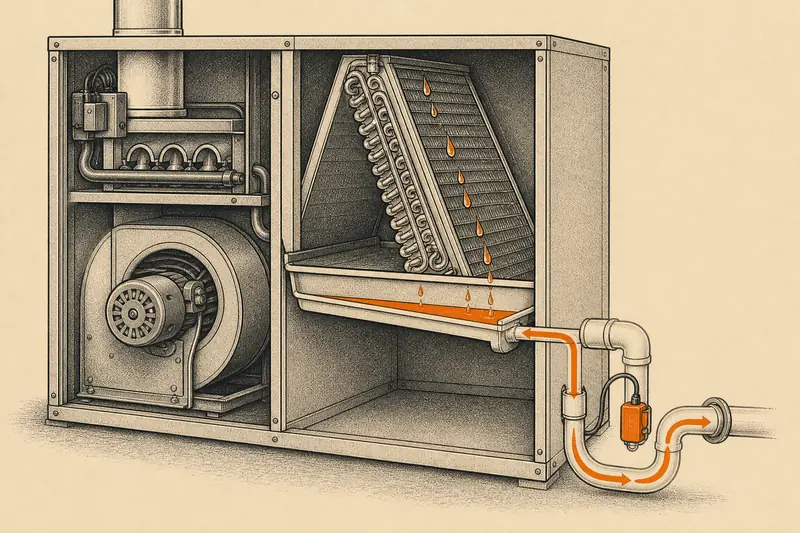
- Carrier describes the condensate line as a ¾-inch PVC pipe carrying water from the cooling coil to a drain outside (Carrier).
- Signs of a clog, per Carrier: musty smells, standing water, water damage near the unit, loss of cooling, or a system that shuts itself off.
- Lennox's homeowner manual says to check the indoor drain line for obstructions monthly, including any auxiliary drain.
- Carrier's DIY method: power off, then a cup of distilled vinegar at the indoor access point or a wet/dry vacuum at the outdoor exit.
- A float switch shuts the system down when the drain pan fills; it is a safety device, never something to bypass.
- Standard condensate pumps were listed at $47.61 to $82.20 at PlumbingSupplyAndMore on October 27, 2026, part only.
How do you know the condensate line is clogged?
The usual first sign is water where it shouldn't be: in the pan under the indoor coil, on the floor of the furnace closet, or stains on a ceiling under an attic unit. Carrier's list of symptoms adds "musty, moldy smells" from the vents, loss of cooling, and a system that turns off or refuses to start, "often triggered by a safety float switch" (Carrier, How to Clean AC Drain Line).
Lennox adds rust on the drain pan and higher indoor humidity to the list (Lennox, AC drain line clogged). It also says that dripping from the outdoor end of the line while the AC runs means the system is working. If the AC is running and nothing comes out, Carrier's FAQ says the likely causes are a clogged line, a frozen coil or a disconnected pipe; a frozen coil has its own fix on AC not cooling.
Why it matters: ENERGY STAR's checklist says "a plugged drain can cause water damage in the house and affect indoor humidity levels" (ENERGY STAR maintenance checklist). The clog itself is sludge: Carrier explains that dust caught on the wet coil mixes with the water and travels into the line.
How do you clear a condensate line safely?
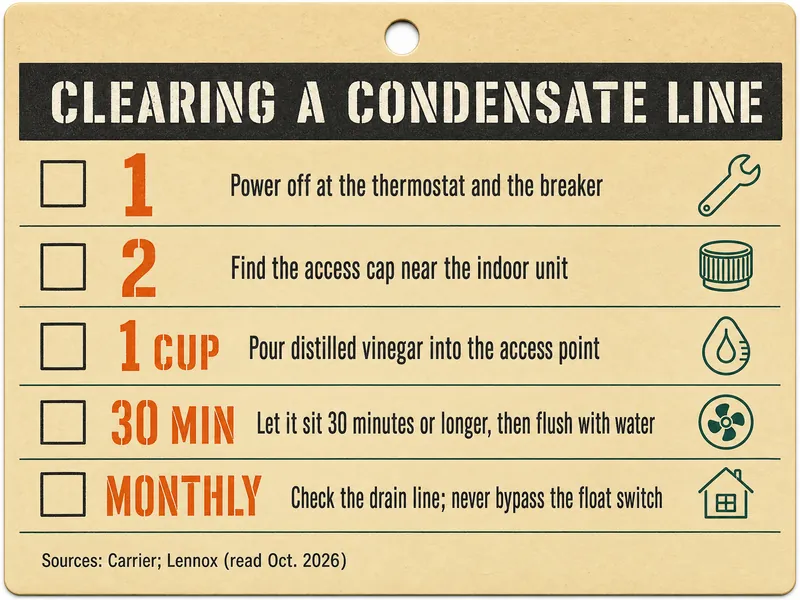
Shut the system off at the thermostat and at the breaker first, then work from the indoor access cap or the outdoor drain exit. Carrier's quick guide says to "turn off your air conditioning unit to ensure safety," and Lennox puts it more plainly: "working with water and electricity can be dangerous."
- Set the thermostat to Off, then switch off the breaker or service switch for the indoor unit.
- Find the line. Lennox says it is usually near the air handler inside and runs out near the condenser outside. Lennox's steps assume a removable cap on the line near the indoor unit.
- Look in. Lennox says to remove the cap and check for debris with a flashlight.
- Clear it. Carrier says to "use a wet/dry vacuum to suction out the clog from the outdoor drain line exit" or to pour vinegar in at the indoor access point (next section).
- Empty and wipe the drain pan if water is standing in it, then refit the cap, restore power and watch for water dripping at the outside end.
Stop and call if the clog is out of reach, keeps coming back, or water has already soaked a ceiling or subfloor. Lennox names those three cases (extensive water damage, recurring clogs, an unreachable clog) as the time for a technician. Don't push a snake hard into an unknown line: Carrier notes a pro has the tools to clear it "without damaging the PVC piping." If you're unsure, call a licensed technician.
What should you flush the line with?
Distilled vinegar is the makers' default. Carrier says to "pour a cup of distilled vinegar into the indoor access point to dissolve buildup," and Lennox says to pour diluted vinegar or a cleaner approved for PVC and "let it sit for 30 minutes or longer. Then, flush the line with water."
Hot tap water also works on light buildup. Carrier's FAQ says "pouring hot (not boiling) water ... can help dissolve minor buildup. Always turn off the power first." Boiling water is the line to avoid: the pipe is plastic.
Know the limits of any pour-in product. Carrier's page relays a Texas contractor's caution that vinegar and bleach "may not fully prevent blockages because many clogs are caused by debris or buildup that is not organic material." Lennox suggests flushing every few months as prevention, and Carrier suggests asking your technician to show you the vinegar pour at a tune-up.
| Step | Carrier | Lennox |
|---|---|---|
| Power | Turn off the AC first | Turn off the AC; water and electricity are dangerous |
| Find the line | Access point near the indoor unit; exit outdoors | Near the air handler inside and the condenser outside |
| Clear | Wet/dry vacuum at the outdoor exit | Remove the cap and inspect with a flashlight |
| Flush | 1 cup of distilled vinegar; hot, not boiling, water | Diluted vinegar or PVC-safe cleaner, 30 minutes, then water |
| How often | Ask a tech to show you between visits | Check monthly (manual); flush every few months |
What does a float switch do?
A float switch sits in or beside the drain pan and cuts the system off when water rises, so a clog becomes a warm house instead of a wet ceiling. Carrier's FAQ: "If a clog causes the drain pan to fill with water, this switch triggers the system to shut down completely to prevent water damage to your ceilings or floors." Trane says some states do not require one when the condensate is piped outside, and suggests having a licensed technician add an overflow switch if you are worried about water damage (Trane, air handler dripping water).
When a float switch trips, clear the drain and empty the pan; the system should restart once the water is gone. Never tape, jumper or remove a float switch to get the cooling back; it is the only thing between a clog and a flood. A switch that keeps the system off with a dry pan needs a technician.
Condensate numbers with their sources
When is the condensate pump the problem?
Suspect the pump when the drain has nowhere to fall to, such as a basement furnace, and water collects around the pump beside the furnace or air handler. Carrier lists "a condensate pump or drainage problem" among the top reasons a furnace leaks water, and notes that furnaces rated 90% AFUE or higher make condensation as they pull heat from combustion gases (Carrier, furnace leaking water). So a pump can be busy in winter as well as summer.
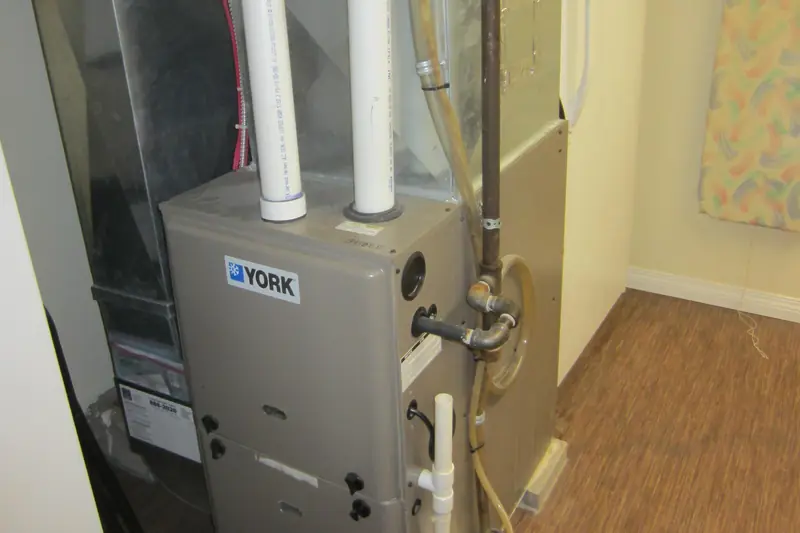
The homeowner checks are short. Carrier's furnace page says to turn off the power, look for standing water, and "verify the pump is functioning," but not to take internal parts apart; a blocked, damaged or hard-to-reach pump is a job for a technician. Trane adds that a unit in a basement utility room may drip for a while before anyone notices, so look at the floor when you change the filter.
For price reference, condensate pumps were listed at $47.61 to $82.20 at PlumbingSupplyAndMore on October 27, 2026 (part only, standard models; a flat pump with a built-in neutralizer listed at $181.37). The supply house is under the same ownership as Penny Damper. Labor on top depends on local rates and on how the pump is wired and piped; get the diagnosis and an itemized quote in writing.
Gas furnaces bring their own safety items: a yearly professional inspection and working carbon monoxide alarms, covered on carbon monoxide and your furnace. The HVAC upkeep hub lists every safe job in one place, and whole-house humidifiers covers the other water source that can leak near a furnace.
How these numbers were checked
This page is based on Carrier's "How to Clean AC Drain Line" and "Furnace Leaking Water" pages, Lennox's clogged drain line article and AC homeowner manual, Trane's air handler dripping water page, and ENERGY STAR's maintenance checklist, all read October 27, 2026. The pump price range was read from PlumbingSupplyAndMore's condensate pump listings the same day. Left out: brand-name drain tablets and cleaners, any labor price, and pump replacement steps, which belong to a technician.
More questions
Can you use bleach instead of vinegar in an AC drain line?
Carrier and Lennox both name vinegar; Lennox also allows a cleaner approved for PVC. Neither maker's steps call for bleach, and Carrier's page notes pour-in products may not stop clogs caused by non-organic debris. Never mix bleach with vinegar or other cleaners.
How often should you flush a condensate line?
Lennox's manual says to check the drain line monthly, and its article suggests flushing every few months.
Why is water dripping from a pipe above a window or door?
Lennox says many systems have a secondary drain line that usually exits above a door or window. Water there means the primary line is blocked and the backup is doing its job. Clear the main line soon.
Will a clogged condensate line stop the heat?
It can on a high-efficiency furnace. Carrier says furnaces rated 90% AFUE or higher produce condensate, and a blocked drain or failed pump can leave water around the unit. Some systems shut down when a float or wet switch detects water.
Is it safe to run the AC with the float switch tripped?
It won't run, by design, and it should not be forced to. Clear the drain and empty the pan so the switch can reset. If it trips again soon, call a technician.
How long does a condensate pump last?
No source fetched gives a lifespan. The sign Carrier names is standing water around the unit. It says to confirm the pump is running but not to take it apart, and to have a technician handle a blocked or damaged pump.
Can a wet/dry vacuum damage the drain line?
Carrier names a wet/dry vacuum at the outdoor exit as its homeowner method, so used there it is the gentle option. The risk to PVC comes from forcing snakes or tools into the line, which Carrier leaves to a pro.
More water and drain jobs
Back to the Penny Damper front page