AC Compressor Replacement: Worth It?
Short answer
AC compressor replacement cost is high because the refrigerant has to be recovered and recharged by an EPA-certified technician; on a unit over 10 years old, price a new system too.
Penny Damper bench notes · updated
Partner links on this page go to PlumbingSupplyAndMore, under the same ownership as Penny Damper. They are there for price reference and examples; no figure here depends on them. How partner links work
Jump to a section
Shop notes
- Replacing a compressor means opening the sealed refrigerant circuit, which only technicians certified under EPA Section 608 may do.
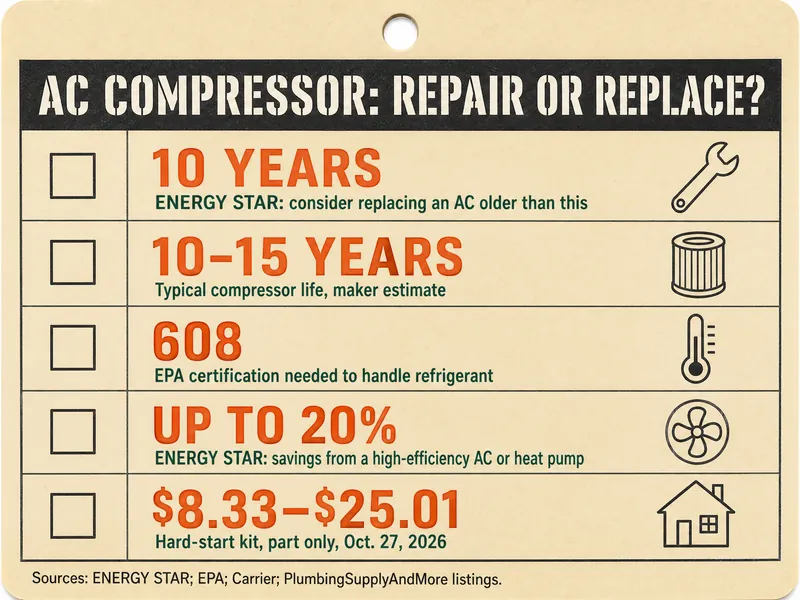
- ENERGY STAR says to consider replacing an air conditioner or heat pump that is more than 10 years old.
- Carrier puts typical compressor life at 10 to 15 years, its own estimate.
- A capacitor, contactor or tripped breaker often looks like a dead compressor; a round dual run capacitor listed for $8.96 to $19.21 on October 27, 2026, part only.
- Hard-start kits listed at $8.33 to $25.01 the same day; a Goodman bulletin says start assist will not prevent failure on a low-voltage supply.
- ENERGY STAR says high-efficiency units, installed correctly, can save up to 20 percent on heating and cooling costs.
Why does a compressor replacement cost so much?
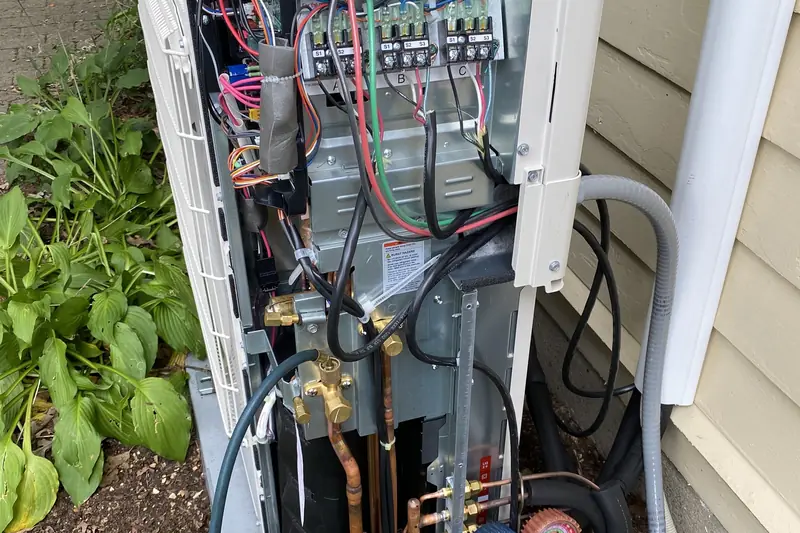
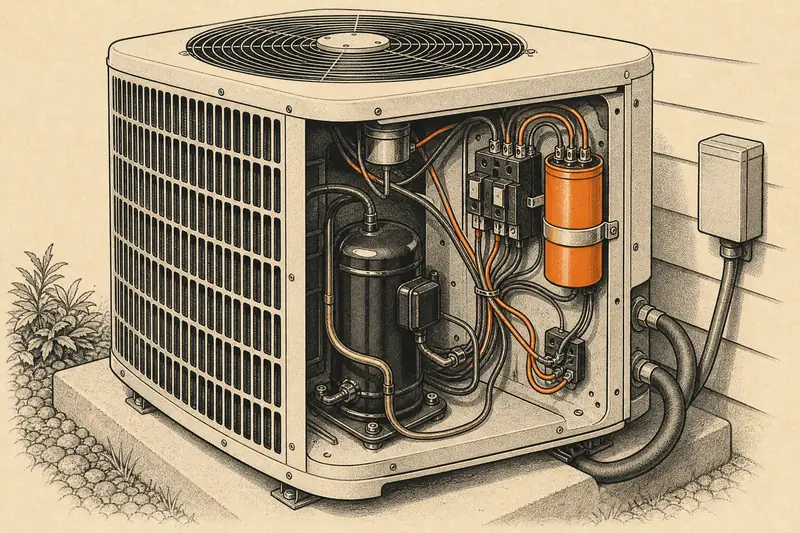
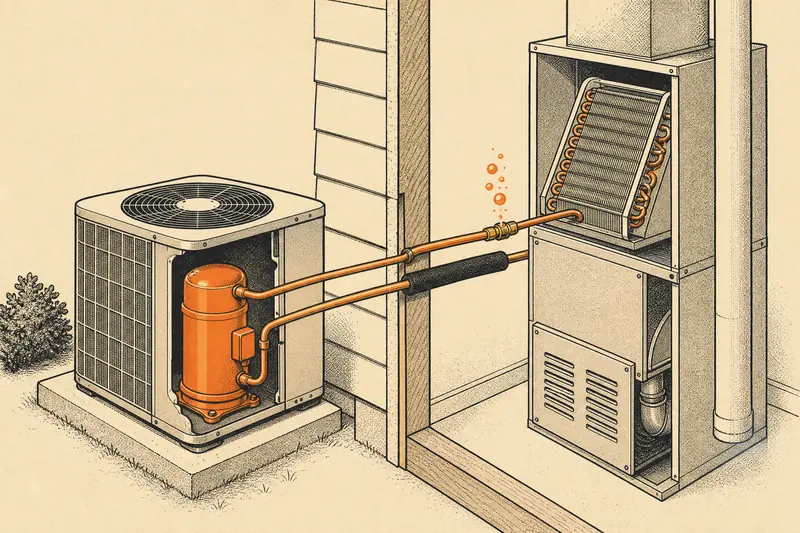
The compressor is the pump at the center of the cooling cycle, and swapping it is the longest job in the outdoor unit. Carrier calls it the part that "circulates refrigerant" between the indoor and outdoor coils. To replace it, a technician has to recover the refrigerant, cut the old compressor out of the copper lines, braze in the new one, pull a vacuum and recharge, then test the system.
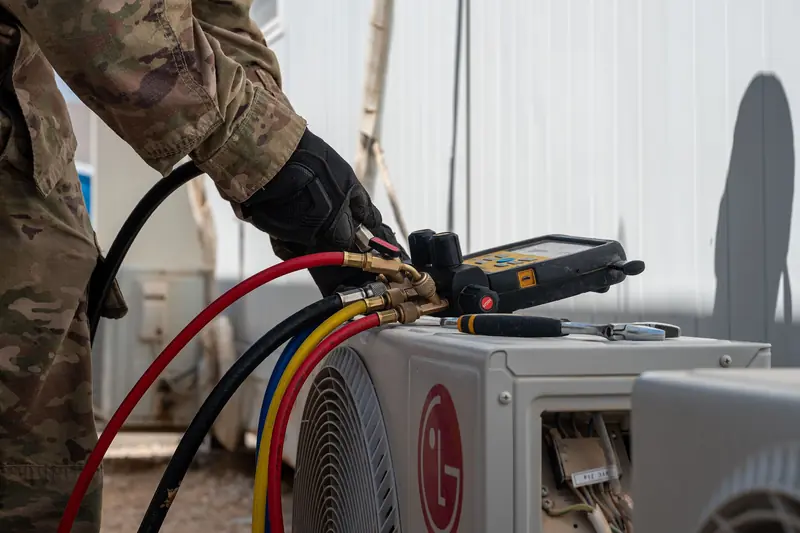
Each step needs a certified person and specialized equipment. EPA says technicians "who maintain, service, repair, or dispose of equipment that could release refrigerants into the atmosphere must be certified," and its sales restriction means only certified technicians may buy refrigerant. Venting refrigerant on purpose is illegal. If your system runs on R-410A, EPA's 2026 final rule says repairs are still allowed, but it also expects refrigerant prices "may rise" as the phasedown goes on.
Penny Damper doesn't print a total for this job; it depends on the compressor, the tonnage, the refrigerant and your local rate. What we can give is the pay behind the hours: BLS reports a $29.33 hourly median, $61,010 a year, for HVAC mechanics in May 2025. A company bills more than its tech earns, since the rate also carries the truck, insurance, recovery machine and vacuum pump. Ask for the diagnosis and an itemized written quote that separates the compressor, refrigerant and labor.
| Situation | What it points to | Who says so |
|---|---|---|
| Unit under 10 years, compressor under warranty | Repair is often worth pricing | Carrier |
| Unit over 10 years old | Consider replacing the whole system | ENERGY STAR |
| Compressor fails and the refrigerant also leaked | Leak repair plus recharge on the same bill | EPA Section 608 rules |
| Both outdoor unit and indoor coil replaced | Counts as a new system under EPA rules | EPA |
What makes a compressor fail?
Compressors usually die from electrical stress, overheating or refrigerant problems, rarely from age alone. Lennox's guide to an AC compressor not turning on lists a failed capacitor or contactor, low refrigerant from a leak, and overheating that trips the internal overload. It says outright failure comes from "long-term electrical stress or mechanical wear."
Several of those causes are cheap to prevent. A clogged filter starves the indoor coil of air, and ENERGY STAR's maintenance checklist warns that a dirty filter "can increase energy costs and damage your equipment, leading to early failure." Dirty coils make the system run longer, and a wrong refrigerant charge shortens equipment life, the same checklist says.
Voltage matters too. A Goodman service bulletin on hard-start kits (2005) names low voltage, slow equalization of system pressures and a "tight" compressor as the common causes of hard starts. A failing capacitor adds strain each time the compressor tries to start, and Carrier warns that a unit left running on one risks lasting compressor damage.
What can you check before blaming the compressor?
Check the thermostat, the breaker, the outdoor disconnect and the filter first; a dead-looking compressor is often a cheaper part. Lennox's list matches: set the thermostat to Cool below room temperature, change dead batteries, reset a tripped breaker once, and make sure the disconnect switch beside the outdoor unit is on.
- Thermostat on Cool, set below the room temperature, fresh batteries.
- Breaker for the outdoor unit on. Reset it one time; a second trip means a fault, so call.
- Filter clean. A clogged one can freeze the coil.
- Leaves and grass cleared off the outdoor unit's coil guard, after its disconnect is switched off.
- If the unit shut down on a hot afternoon, Lennox suggests waiting 30 minutes before restarting.
Stop there. Capacitors hold a charge after the power is off, and refrigerant work is off-limits to anyone without EPA certification; see why topping up refrigerant isn't a repair. If the outdoor unit hums or clicks without starting, the capacitor is a likely suspect and a far cheaper repair, covered on the capacitor cost page. If you're unsure, call a licensed technician. Tell them what you heard and when it started; that shortens the diagnosis.
Compressor numbers
- 10 yearsAge at which ENERGY STAR says to consider replacing an AC or heat pumpENERGY STAR
- 10–15 yearsTypical compressor life, maker estimateCarrier
- Up to 20%Savings on heating and cooling costs from high-efficiency units installed correctlyENERGY STAR
- $8.33–$25.01Hard-start kits as listed Oct. 27, 2026, before laborPlumbingSupplyAndMore (under the same ownership as Penny Damper) (PlumbingSupplyAndMore, under the same ownership as Penny Damper)
- $61,010Median yearly pay, HVAC mechanics, May 2025BLS
Does the warranty cover the compressor?
Often the part is covered and the labor is not, so read the certificate before you approve anything. Carrier advises checking whether your parts and labor are covered before authorizing repairs, because coverage varies by manufacturer. Registration can change the term: Goodman's warranty explainer says an unregistered unit gets a 5-year parts limited warranty, while one registered online within 60 days of installation can get 10 years, with a lifetime compressor warranty on select models.
Goodman also notes that some states, including California, Florida and Georgia, don't let makers condition coverage on registration. Other brands set their own terms, so find the model and serial number on the outdoor unit's rating plate and ask the installer for the certificate. A covered compressor still leaves you paying for refrigerant, the brazing work and the hours, which is why the written quote should list them separately.
Some technicians suggest a hard-start kit on an older compressor that struggles to start. Kits were listed at $8.33 to $25.01 on October 27, 2026, part only, on the hard-start kit page of a supply house that shares owners with Penny Damper. Goodman says its own kits don't void its warranties; whether one suits your unit is the technician's decision.
When is a new system the better buy?
When the unit is past 10 years old, out of warranty or leaking refrigerant, a whole new system usually deserves a quote next to the compressor repair. That 10-year line is ENERGY STAR's. Carrier makes the same call for systems over 10 years old, and Lennox says a compressor that is 10 to 15 years old or "racking up repair bills" makes replacement "worth serious consideration."
Efficiency is the other half of the math. ENERGY STAR says high-efficiency units installed correctly "can save up to 20 percent on heating and cooling costs," and it warns that improper installation can cut system efficiency by up to 30 percent, so the installer matters as much as the label. Every new central AC must meet the SEER2 minimums in force since 2023. To see what complete systems are sold as, the same supply house lists unitary HVAC equipment (PlumbingSupplyAndMore, under the same ownership as Penny Damper).
Run the numbers on two written quotes, one for the compressor and one for a system, and use the repair-or-replace test. Federal 25C credits no longer apply to equipment installed after December 31, 2025, per the IRS; rebates and other help that remain are on the tax credits page.
How these numbers were checked
Sources, each read in October 2026: EPA's Section 608 pages and its 2026 refrigerant rule in the Federal Register; ENERGY STAR's replacement and maintenance pages; Carrier's and Lennox's compressor guides; Goodman's warranty explainer and its 2005 hard-start bulletin; and the BLS handbook's May 2025 wage figures. The one part price here is the hard-start kit range from PlumbingSupplyAndMore's October 27, 2026 listings, without labor. Left out: total compressor or system prices, cost-guide figures and refrigerant charge weights.
More questions
Can a compressor be replaced without replacing the coil?
Yes. EPA's refrigerant rules allow systems to be "repaired over time," and only replacing every component counts as a new system. Whether a mismatched old coil makes sense with a new compressor is a question for the technician's written quote.
Is a compressor on an R-410A system still repairable?
Yes. In its 2026 rule EPA says it sees no need to limit repairs on R-410A equipment, and the refrigerant stays available for service work. EPA expects prices for that refrigerant may rise.
Why does my outdoor unit hum but the fan doesn't spin?
A humming unit that won't start is a classic capacitor sign, not proof of a dead compressor. Turn the system off at the thermostat so the motors don't overheat, and have a technician test the capacitor first.
Does a lifetime compressor warranty cover labor?
Usually not unless the certificate says so. Read the terms, check whether registration was done within the maker's deadline, and ask the installer about any separate labor warranty.
How long should I wait after the compressor overheats?
Lennox suggests waiting 30 minutes before restarting a compressor that shut down from overheating. If it keeps happening, something such as a dirty coil, low refrigerant or a failing capacitor needs a diagnosis.
Can I add refrigerant to get through the summer?
No. Only EPA-certified technicians may buy or handle refrigerant, and a low charge means a leak. Adding refrigerant without fixing the leak pays for the same refrigerant again next season.
Is a hard-start kit a fix for a failing compressor?
No. Goodman's 2005 bulletin calls start components no cure for a low-voltage supply. It adds that a compressor that is merely tight tends to free itself once it has run for a while.
Related repair costs