MERV Ratings and Furnace Filters
Short answer
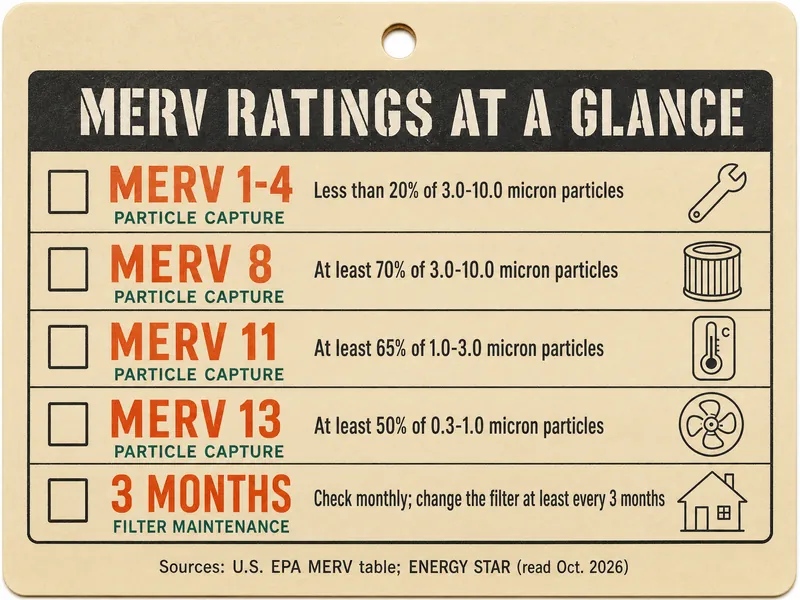
MERV ratings run from 1 to 16 and tell you how much fine dust a furnace filter traps; EPA suggests at least MERV 13 if your system can take it, changed at least every 3 months.
Penny Damper bench notes · updated
Partner links on this page go to PlumbingSupplyAndMore, under the same ownership as Penny Damper. They are there for price reference and examples; no figure here depends on them. How partner links work
Jump to a section
Shop notes
- MERV ratings come from an ASHRAE test method and report how well a filter captures particles between 0.3 and 10 microns (EPA).
- EPA's advice: at least MERV 13, or as high as your system fan and filter slot can accommodate, and ask an HVAC technician if you are not sure.
- A MERV 13 filter must catch at least 50% of the finest particles in the test (0.3 to 1.0 microns); MERV 8 has no minimum in that range.
- ENERGY STAR's rule: look at the filter monthly, and never let one stay in longer than 3 months (ENERGY STAR).
- Pleated 1-inch MERV 8 filters in common sizes were listed at $5.22 to $14.17 each at PlumbingSupplyAndMore on October 27, 2026.
- The size printed on the frame is nominal: a 16 x 25 x 1 filter may measure 15.5 x 24.5 x .7 inches (Trane).
What does a MERV rating mean?
A MERV rating is a number from 1 to 16 that says how well a filter captures airborne particles between 0.3 and 10 microns. EPA explains that the rating "is derived from a test method" developed by ASHRAE, the engineering society for heating and cooling (EPA, What is a MERV rating?). Higher numbers catch a larger share of small particles.
EPA's table sorts particles into three size bands: 3.0 to 10 microns, 1.0 to 3.0 microns, and 0.3 to 1.0 microns. The top of the chart, MERV 16, catches 95% or more of the smallest band. The jump that matters for a home is between MERV 8 and MERV 13, shown below.
| MERV | 0.3–1.0 microns | 1.0–3.0 microns | 3.0–10.0 microns |
|---|---|---|---|
| MERV 1–4 | not rated | not rated | less than 20% |
| MERV 8 | not rated | 20% or more | 70% or more |
| MERV 11 | 20% or more | 65% or more | 85% or more |
| MERV 13 | 50% or more | 85% or more | 90% or more |
MERV 8 vs MERV 11 vs MERV 13: which one?
For most homes the answer is the highest of the three that your system handles without strain, and EPA names MERV 13 as the target. Its wording: "choose a filter with at least a MERV 13 rating, or as high a rating as your system fan and filter slot can accommodate." The table above shows why: MERV 8 has no required capture in the finest band, MERV 11 needs 20% and MERV 13 needs 50%.
MERV 8 is the cheapest pleated option most supply houses stock. For a price anchor, pleated 1-inch MERV 8 filters in common sizes were listed at $5.22 to $14.17 each at PlumbingSupplyAndMore on October 27, 2026 (part only). If air quality is the reason you are shopping, the gap between MERV 8 and MERV 13 in the finest band is the part that matters.
Filter numbers worth knowing
- 1–16MERV scale on EPA's chartEPA
- 50%minimum capture of 0.3–1.0 micron particles at MERV 13EPA
- 3 monthslongest ENERGY STAR says to go between changesENERGY STAR
- 60–90 daysreplacement interval makers typically recommendEPA
- 15%efficiency lost to airflow problems, at mostENERGY STAR
Can a high-MERV filter hurt your system?
Usually not, if you change it on time. EPA's Guide to Air Cleaners in the Home says "most furnaces and HVAC systems can accommodate a MERV 13 filter without creating equipment problems, provided that the filter is replaced frequently." The same page adds: "To be certain a filter will work with your system, consult a professional HVAC technician."
The risk is a loaded filter, not the rating itself. ENERGY STAR warns that a dirty filter slows airflow and "can increase energy costs and damage your equipment, leading to early failure" (maintenance checklist), and the same checklist puts the efficiency loss from airflow problems at up to 15 percent. Starved airflow is also one route to a frozen cooling coil, covered on AC not cooling, and it makes the blower work harder, which matters when a blower motor is already old.
If you move up from MERV 8 to MERV 13 in a 1-inch slot, check the filter after two or three weeks the first time. If it is already grey, shorten the change interval rather than going back down. If a room starts to feel weak at the registers, or the system short-cycles, have a technician measure airflow before blaming the filter. If you're unsure, call a licensed technician.
How often should you change a furnace filter?
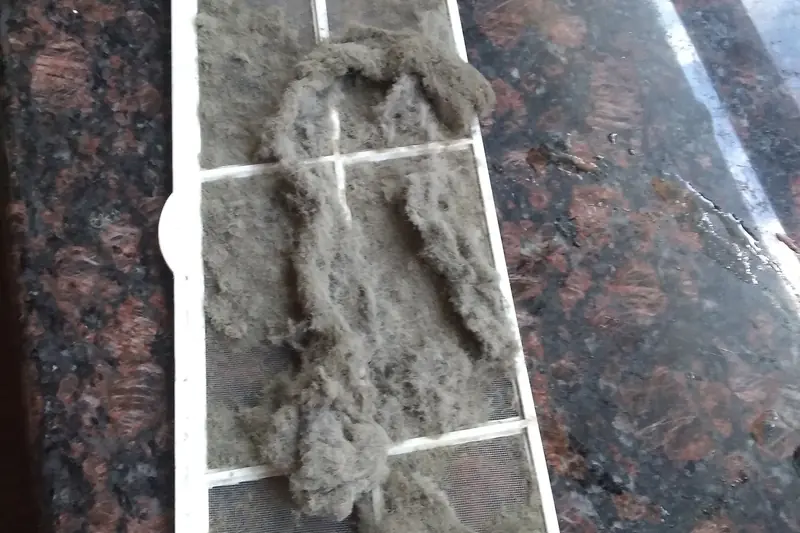
Look at it monthly and swap it no later than the 3-month mark. ENERGY STAR's exact advice: "Check your filter every month, especially during heavy use months (winter and summer). If the filter looks dirty after a month, change it." EPA adds that makers "typically recommend replacement every 60 to 90 days."
Thicker filters last longer. Carrier says many 1-inch filters need replacing every 30 to 90 days, while thicker 4-inch media filters may last 6 to 12 months (Carrier furnace troubleshooting). Pets, a dusty renovation, or a system that runs most of the day all push you toward the short end. Heat pumps run in both seasons, and DOE's Energy Saver Guide tells their owners to clean or change filters once a month or as needed (more on heat pump settings).
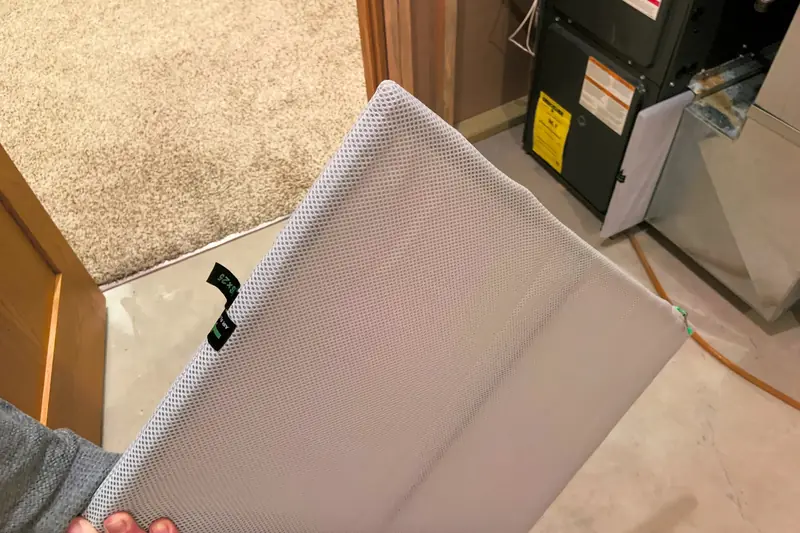
The swap itself is quick. Turn the system off at the thermostat first. Lennox's homeowner manual says disposable filters "should be replaced with a filter of the same type and size," and it wants every access panel closed and a filter fitted before the unit runs (Lennox manual). Write the date on the frame with a marker so the next check is easy.
How do you find the right filter size?
Read the three numbers printed on the edge of the filter you already have, then buy that nominal size. Trane's furnace filter guide explains that the label is rounded: "The actual size might be half an inch smaller than the size you need to buy," so a 16 x 25 x 1 filter may measure 15.5 x 24.5 x .7 inches. Measure the slot only if the old filter is missing or unreadable.
Direction matters too. Trane says to slide the filter in "with the arrow pointing to the furnace," which means the arrow follows the airflow from the return duct toward the blower. A filter put in backward or a size too small lets air slip around the edges, and that bypass dust ends up on the blower wheel and the cooling coil. Gaps around a filter rack are a cousin of the duct leaks that waste conditioned air.
If the slot holds a 4-inch or 5-inch media cabinet, the size is usually printed inside the cabinet door. Some homes also have filters behind return grilles in a wall or ceiling instead of at the furnace; check every return so none goes years without a change.
Where do filters fit in the rest of your upkeep?
A clean filter is the cheapest job on the HVAC upkeep list, and it protects everything downstream of it. Trane's filter myths page gives the same 1 to 16 range EPA uses, so treat any "MERV 20" claim on a home filter package with suspicion. Other ratings you may see on packaging are store-brand scales, not MERV.
Penny Damper shares owners with PlumbingSupplyAndMore, whose indoor air quality section lists filters by MERV and size; the box below links it for dated prices. A furnace-mounted humidifier has its own pad to change each season, covered on whole-house humidifiers.
How these numbers were checked
This page is based on EPA's "What is a MERV rating?" page and its Guide to Air Cleaners in the Home, ENERGY STAR's heating and cooling and maintenance checklist pages, Trane's furnace filter guide and filter myths page, Carrier's furnace troubleshooting page and the Lennox AC homeowner manual, all read on October 27, 2026. The filter price range is PlumbingSupplyAndMore's listed price for pleated 1-inch MERV 8 filters in common sizes on that date. Left out: lab tests of brands, store-brand rating scales, and any claim that a given filter cuts a bill by a set amount, since no source fetched gives one.
More questions
Is MERV 13 too restrictive for an older furnace?
EPA says most systems can take a MERV 13 filter without problems if it is changed often. An old blower with a tight 1-inch slot is the case to ask about. Have a technician check airflow, or start with MERV 11 and watch how fast it loads.
Are MERV and MPR the same thing?
No. MERV comes from an ASHRAE test method and runs 1 to 16 on EPA's chart. Other numbers on packaging are a seller's own scale, so compare filters by the MERV figure when one is printed.
Can you wash and reuse a disposable pleated filter?
No source here supports washing a disposable filter. Lennox's manual says disposable filters should be replaced with one of the same type and size. Washable filters are sold as their own type, with their own care instructions.
Why does my new filter turn grey within a month?
That is the filter doing its job, and it often means dust is high from pets, construction or leaky return ducts. ENERGY STAR says to change it if it looks dirty after a month. If it loads unusually fast, look for gaps around the filter rack or a return pulling air from an attic.
Should a home have both a return grille filter and a furnace filter?
Two filters in series add resistance to airflow, and no source here recommends doubling up. If you have both, ask a technician which one to keep. Either way, check every return so none is forgotten.
Does a higher MERV filter lower my energy bill?
No source fetched says so. The bill effect comes from keeping any filter clean: ENERGY STAR says a dirty filter slows airflow and wastes energy. Pick the MERV for air quality, then change it on time.
What does the arrow on a filter mean?
It shows the direction of airflow. Trane says to slide the filter in with the arrow pointing toward the furnace. A backward filter can sag or let dust through.
Keep going
Back to the Penny Damper front page