Humidifiers, Hard Water and Upkeep
Short answer
Whole-house humidifiers should hold indoor humidity between 30 and 50 percent, EPA says; hard water leaves scale on the pad, so most furnace-mounted units need a new water panel every season.
Penny Damper bench notes · updated
Partner links on this page go to PlumbingSupplyAndMore, SoftPro Water Systems, under the same ownership as Penny Damper. They are there for price reference and examples; no figure here depends on them. How partner links work
Jump to a section
Shop notes
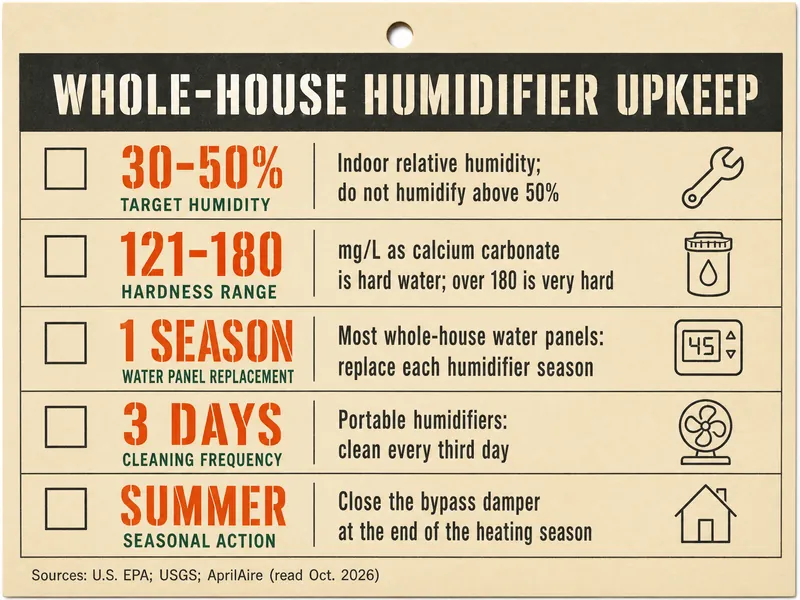
- EPA: keep indoor relative humidity "ideally between 30 percent and 50 percent," and "do not humidify" above 50 percent (EPA).
- Condensation on windows, walls or pictures is EPA's signal to lower the humidistat or run the humidifier less.
- USGS calls water with 121 to 180 mg/L of hardness (as calcium carbonate) hard, and over 180 mg/L very hard (USGS).
- EPA says minerals in tap water "may increase the development of crusty deposits, or scale, in humidifiers," and scale can harbor microorganisms.
- AprilAire says most of its whole-house water panels should be replaced every humidifier season, and its Model 400 panel every 3 months of the season.
- EPA says portable humidifiers need cleaning every third day; furnace-mounted units follow the maker's directions.
What humidity should a home have in winter?
Aim for 30 to 50 percent relative humidity and stay under 50. EPA's mold course says indoor humidity "should be kept below 60 percent -- ideally between 30 percent and 50 percent, if possible" (EPA, Mold Course Chapter 2), and its humidifier page says flatly: "Do not humidify to indoor relative humidity levels exceeding 50 percent." Higher levels, it says, may encourage biological growth in the home.
Makers sometimes quote higher targets; AprilAire's water panel article cites 40 to 60 percent. Penny Damper follows EPA's cap of 50 because it is the health-agency figure. A cheap hygrometer tells you where you are, and EPA's own test is simpler still: "If water condenses on windows, walls, or pictures, relocate the humidifier, lower its humidistat setting, or reduce its use."
How does a whole-house humidifier work?
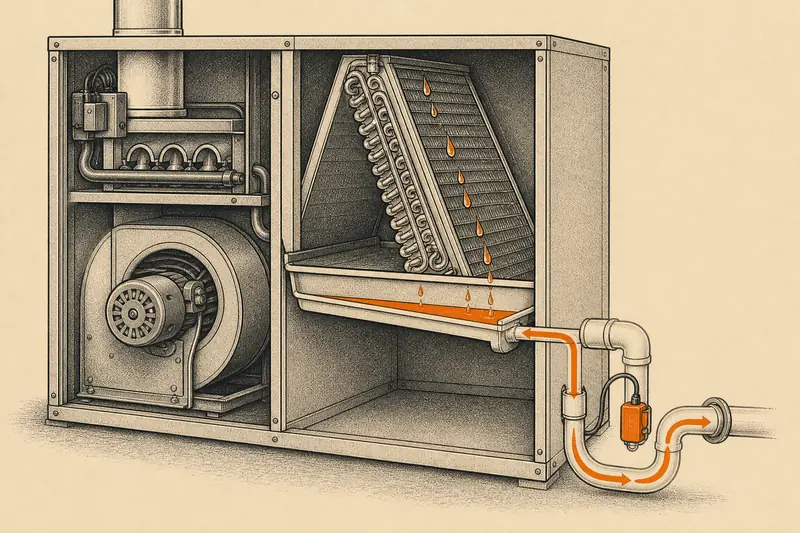
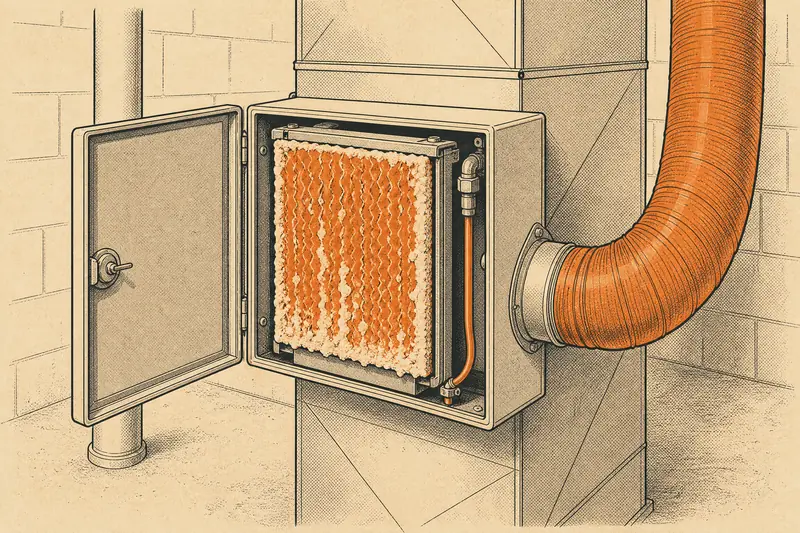
Most furnace-mounted humidifiers are evaporative: water runs over a panel, and the furnace blower pushes air through it to pick up moisture. AprilAire says plainly that its humidifiers "are an evaporative-style humidifier" (AprilAire owner FAQ). It adds that its units need heat, water and air movement, and they only add moisture while the HVAC fan is moving air.
Bypass models connect to the ductwork through a small bypass duct with a damper, which AprilAire says is the summer/winter knob you close for the off-season. Drain-through models send leftover water to a drain; AprilAire says that flow "serves the important function of flushing away mineral deposits" from the panel. Steam units boil water instead. EPA notes that "steam vaporizer and evaporative humidifiers are not expected to disperse substantial amounts of minerals."
Heat pumps change the math. AprilAire says its Model 400 can run on a heat pump system, but because heat pumps deliver lower-temperature air than gas furnaces, "evaporation will be approximately 60% of our rated capacity." See heat pump settings for the rest of the heat pump routine.
| Type | How it adds moisture | Mineral note |
|---|---|---|
| Evaporative (furnace-mounted bypass or fan) | Air passes through a wet water panel | Minerals stay on the panel; EPA doesn't expect much dispersal |
| Drain-through evaporative | Extra water flushes the panel to a drain | AprilAire says the flow flushes away deposits |
| Steam (furnace-mounted) | Boils water into vapor | EPA doesn't expect much mineral dispersal |
| Ultrasonic or impeller (portable) | Throws a fine mist | EPA says these disperse tap-water minerals as "white dust" |
Why does hard water matter for humidifiers?
USGS defines hardness as "the amount of dissolved calcium and magnesium in the water," and when water evaporates off a humidifier pad those minerals stay behind. AprilAire puts it this way: "some of the minerals left behind from the evaporation process are permanently trapped in the water panel," which "will eventually become clogged with these minerals so less evaporation takes place." A crusted panel means a drier house for the same running time.
EPA's concern is wider. It says minerals in tap water "may increase the development of crusty deposits, or scale, in humidifiers. Scale can be a breeding ground for microorganisms." For portable ultrasonic and impeller units, EPA also notes "white dust" on furniture, and says "distillation is the most effective method for removing minerals from water."
Humidity and hardness numbers with their sources
- 30–50%indoor relative humidity EPA calls idealEPA
- 50%level EPA says not to humidify aboveEPA
- 121–180 mg/Lhardness USGS classifies as hardUSGS
- 60%share of rated output an AprilAire Model 400 reaches on a heat pump, approximatelyAprilAire
- 3 daysEPA's cleaning interval for portable humidifiersEPA
Your water utility's annual quality report or a home test gives your hardness number; compare it with the USGS scale. If it lands in the hard or very hard range, a water softener such as the SoftPro ECO is one way households lower hardness at the tap; Penny Damper shares owners with SoftPro. No source fetched for this page measured whether softened supply water makes a humidifier pad last longer, so treat that as a possibility, not a promise. For portable units, EPA's own advice is distilled or other low-mineral water.
How do you clean a humidifier pad?
On most furnace-mounted units you don't clean it; you replace it. AprilAire says its water panels "are designed to be used for the humidifier season and replaced," with Models 300, 500, 600 and 700 needing a new panel every season and the drainless Model 400 every 3 months during the season. Its water panel article says to change them "annually (10, 12, and 35 Water Panel) or twice per heating season (45 Water Panel)" (AprilAire). Other makers set their own intervals, so read the label inside the cover.
To swap a panel: turn the system off at the thermostat, switch off the furnace power, open the humidifier cover, slide out the old panel, and fit the new one the way the maker's diagram shows. EPA says to follow the maker's directions for "console and central (furnace mounted) humidifiers," and if the unit holds standing water, not to let it sit for long. AprilAire says panels can be changed without a technician, though it suggests asking one about anything else.
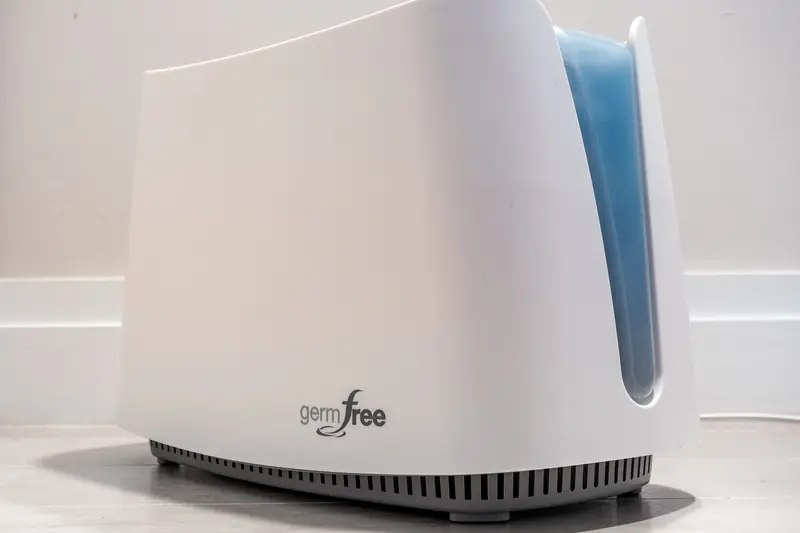
Portable units are different. EPA says to "clean portable humidifiers every third day," unplugging first, and where the maker gives no cleaner, to use a 3% hydrogen peroxide solution on surfaces that touch water, then rinse well. At season's end, AprilAire tells owners of its bypass models 400, 500 and 600 to shut the bypass damper for summer and switch the control off.
Water around the furnace can come from the humidifier rather than the drain. Carrier's furnace page lists "a leaking humidifier, loose water connection or faulty condensate pump" as possible sources; the drain side is covered on clearing a condensate line. Supply valves, solenoids and wiring inside the unit are a technician's job. If you're unsure, call a licensed technician.
Does humidity let you lower the thermostat?
No official source fetched for this site says so, and Penny Damper does not repeat the claim. The settings that do have agency backing are on thermostat settings: DOE suggests no higher than 68°F in winter, with setbacks. A humidifier's job is comfort and keeping indoor air out of the very dry range, within EPA's 30 to 50 percent band.
What a humidifier does cost is water, a panel each season, and some electricity for any fan or steam element. For price reference on air-quality parts, PlumbingSupplyAndMore's indoor air quality section lists filters and related items; the box below links it, and the MERV ratings page covers the filter that sits a few inches from the humidifier. Everything else in the safe-jobs list is on HVAC upkeep.
How these numbers were checked
This page is based on EPA's "Use and Care of Home Humidifiers" page and Mold Course Chapter 2, the USGS hardness page, AprilAire's owner FAQ and water panel article, and Carrier's furnace leaking water page, all read October 27, 2026. Maker replacement intervals are given as AprilAire's own figures for its models. Left out: humidifier prices, softener performance claims, and the "humid air feels warmer" thermostat claim, which no official source fetched supports.
More questions
What humidity is too high in winter?
EPA says not to humidify above 50 percent. Condensation on windows, walls or pictures is the practical warning, and EPA says to lower the setting or move the unit when you see it.
Why is there white dust on my furniture?
EPA links "white dust" mainly to ultrasonic and impeller portable humidifiers, which spray tap-water minerals into the air. Distilled water is EPA's fix. Evaporative and steam units are not expected to disperse much mineral content.
Can you use tap water in a whole-house humidifier?
Furnace-mounted units are plumbed to the house supply, so yes. The trade-off is scale: AprilAire says minerals left by evaporation clog the panel over time, which is why panels are replaced each season.
Should you turn off a whole-house humidifier in summer?
Yes. AprilAire's summer shutdown for bypass models 400, 500 and 600 is to close the bypass damper and switch the control off, or to its bottom setting if it has no off position.
Can you soak a scaled water panel in vinegar and reuse it?
AprilAire says its panels are designed to be replaced, because trapped minerals stay in the panel. A cleaned panel may still pass less water. Follow your maker's instructions.
Do humidifiers grow mold?
EPA says microorganisms often grow in humidifiers with tanks of standing water, and that scale can be a breeding ground. Keep humidity under 50 percent, clean on schedule, and don't let water stand.
Will a water softener stop humidifier scale?
No source fetched for this page tested that. A softener lowers water hardness, and hardness is what leaves scale, but how much it extends pad life is unmeasured here. EPA's tested advice is low-mineral water such as distilled for portable units.
Related upkeep