HVAC Financing Red Flags
Short answer
HVAC financing red flags are a monthly payment with no APR or total, "no interest" offers that charge back interest, pressure to sign the same day, full payment up front, and loans tied to your property tax bill.
Penny Damper bench notes · updated

Jump to a section
Shop notes
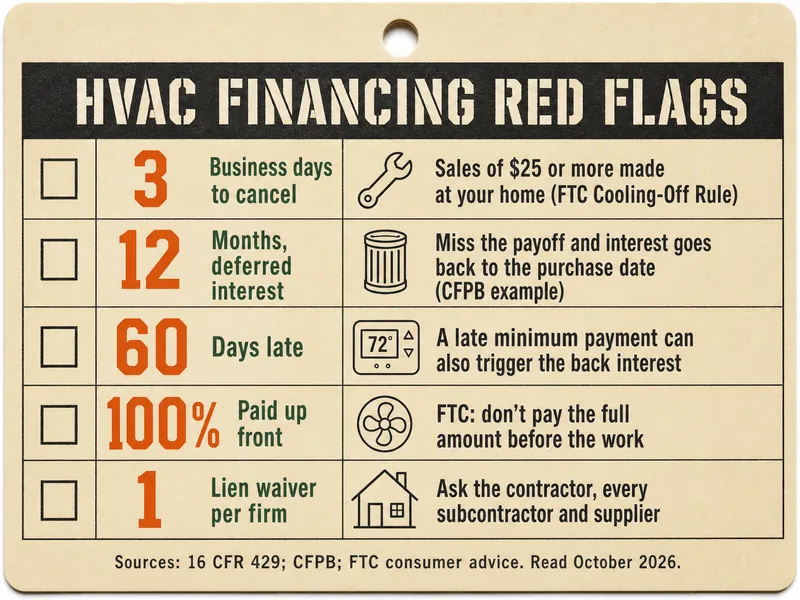
- Under the FTC's Cooling-Off Rule, a sale of $25 or more made at your home can be canceled until midnight of the third business day; Sundays and federal holidays don't count.
- A repair visit you asked for is not covered by that rule, but extra goods or services sold during the visit are.
- On a "no interest if paid in full" deal, the CFPB says missing the payoff charges interest back to the purchase date, and minimum payments "probably won't be enough."
- The FTC says never to agree to contractor financing without shopping around, and not to pay the full price up front.
- PACE loans are repaid through your property tax bill, and the CFPB warns "you may lose your home" if you miss payments; a federal rule effective March 1, 2026 added ability-to-repay checks.
- Unpaid subcontractors or suppliers may be able to file a mechanic's lien on your home, so the FTC says to ask for lien waivers.
What are the red flags in HVAC financing?
The biggest one is being sold a monthly payment instead of a price. A quote that shows "$X a month" without the cash price, the APR, the number of payments and the total you will pay hides the cost of the loan, and the FTC's advice on home improvement scams is blunt: "Never agree to financing through your contractor without shopping around and comparing loan terms."
Watch for these too:
- A same-day deadline. A price that disappears tomorrow is pressure, not a discount. Ask in writing how long the quote is good for.
- "No interest" in large type. Ask whether it is deferred interest, where the interest is charged back if the balance isn't paid in full on time.
- Full payment before the work. The FTC says, "Don't pay the full amount for the project up front."
- A pre-filled emergency waiver. The Cooling-Off Rule lets you give up your three days only for a real emergency, and only with a dated, signed statement in your own handwriting.
- A loan on your property tax bill. That is PACE financing, covered below.
- No lien waivers. Without them, a supplier the contractor didn't pay may come after your house.
None of these means the equipment is wrong. They mean the deal needs a second look, and maybe a second quote, before you sign. If the bigger question is whether to replace at all, the repair or replace test comes first.
How does deferred interest work?
Deferred interest means interest is building up from day one and is waived only if you pay the whole balance by the deadline. The CFPB explains that if you don't pay it all off in the promotional period (12 months in its example), "or if you are more than 60 days late in making a minimum payment," you are charged interest "going back to the date you first made that purchase."
The trap is the minimum payment. The CFPB says minimum payments "probably won't be enough to pay off the entire balance" before the period ends. To stay safe, divide the full balance by the number of promotional months and pay at least that much every month; set it up as an automatic payment.
That differs from a true 0 percent APR, where no interest builds up during the promotion. The contract wording tells you which you have; if it says "deferred," "if paid in full" or "promotional period," ask the lender to point to the back-interest clause before you sign.
Financing numbers to know
- 3 business daysTime to cancel a $25+ sale made at your homeFTC (16 CFR 429)
- $130Cooling-Off threshold for sales at other temporary locationsFTC (16 CFR 429)
- 60 daysLate minimum payment that can also trigger back interest (CFPB example)CFPB
- March 1, 2026Federal PACE rule took effectCFPB
- $2.9 millionSent by the FTC to people harmed by a PACE lender, July 2025FTC
What does the three-day cancellation rule cover?
The FTC's Cooling-Off Rule covers sales of $25 or more made at your home and $130 or more at other places that aren't the seller's regular place of business, and gives you until midnight of the third business day to cancel for a full refund. The FTC's consumer page puts the deadline that way, and the rule defines a business day as any calendar day except Sunday or a federal holiday.
The exception matters for heating and cooling. If you called the company and asked it to come and repair or maintain your system, that repair is not covered. If the technician then sells you something extra during the visit, such as a new system or a service plan, the rule says that sale "would not fall within this exclusion," so the three days apply to it.
Use the time. Get a competing quote, check the equipment's SEER2 rating against your region's minimum, and ask whether any rebate the salesperson promised is real (see tax credits and rebates).
How do you compare a financing offer?
Compare the total you will pay, not the monthly payment. Multiply the payment by the number of payments, add any fees, and subtract the cash price; what is left is the cost of borrowing. Do the same for a bank or credit union loan and for paying cash, and put the three side by side.
| Option | How the cost shows up | Main risk | What to ask for in writing |
|---|---|---|---|
| Contractor's deferred-interest plan | Back interest if not paid in full on time | Interest charged to the purchase date | The payoff date and the back-interest clause |
| Contractor's fixed-rate loan | APR over the full term | A high APR inside a low payment | APR, number of payments, total of payments |
| PACE loan | Added to your property tax bill | Missed payments can cost the home | Total cost and how a sale of the home is handled |
| Bank or credit union loan | APR over the term | Comparing too few lenders | APR and total of payments |
PACE needs extra care. The CFPB says a PACE loan borrows "by increasing your property tax payment," and like a property tax lien, "you may lose your home if you don't make the payments." Since March 1, 2026, a CFPB rule applies ability-to-repay requirements to PACE loans. In July 2025 the FTC sent more than $2.9 million to 960 people harmed by a PACE lender.
Protect the house either way. The FTC's Hiring a Contractor brochure says state laws may let unpaid subcontractors and suppliers file a mechanic's lien, and advises asking the contractor, every subcontractor and supplier for a lien release or lien waiver.
What are the cheaper ways to pay?
The cheapest loan is the one you don't need, so start by shrinking the bill. Get the three free checks done before a service call, and ask for a repair quote alongside any replacement quote; a single failed part usually costs far less than a system. Dated part prices are on the repairs page.
Then look for money that doesn't need repaying. LIHEAP lets states offer low-cost home energy equipment repairs or replacements, and the program never charges a fee for a benefit. The Weatherization Assistance Program serves households at or below 200 percent of the poverty guidelines. Where your state runs them, HOMES and HEEHR rebates can pay part or all of a heat pump. The bill help hub and the LIHEAP page explain how to apply.
If you do borrow, borrow the smallest amount for the shortest term you can afford, from the lender with the smallest total cost, and keep the contractor's price and the loan as two separate decisions.
How these numbers were checked
Based on 16 CFR 429 (eCFR current text), the FTC's Cooling-Off Rule consumer page (September 2025), the FTC's home improvement scam advice (2022) and Hiring a Contractor brochure, the CFPB's deferred-interest and PACE answers, the CFPB's PACE rule page (effective March 1, 2026), an FTC press release (July 8, 2025), ACF's LIHEAP program summary and DOE's weatherization pages, all read October 27, 2026. This is general consumer information, not legal or financial advice. Left out: interest rates, loan offers and lender names, and state lien rules, which vary.
More questions
Does the three-day rule apply to a contract signed at the contractor's office?
The Cooling-Off Rule is written for sales made at your home or at temporary locations such as a booth or a rented room. Don't count on it for a sale signed at the contractor's own office; read the contract's cancellation terms before signing there.
Can a contractor start work during the three days?
The rule includes an emergency exception, but only when you give the seller a separate dated and signed statement in your own handwriting. A pre-printed waiver doesn't meet that test.
Is "same as cash" financing the same as 0 percent APR?
Not always. A "same as cash" offer can be deferred interest, and the CFPB's example of that kind of deal charges interest back to the purchase date if any balance remains when the promotion ends.
What should a financing contract show?
At minimum, the cash price, the APR, the number and amount of payments, the total of payments, any fees, and the payoff date of any promotion. If any of these is missing, ask for it in writing before you sign.
Is it a bad sign if the contractor asks for a deposit?
A deposit on its own is normal; full payment before any work is the warning sign, per the FTC. Tie later payments to finished stages of the job.
What if the lender is the contractor's only option?
You can still take the lender's paperwork home and compare it with a bank or credit union quote. A contractor who won't give you the terms in writing to compare is a reason to get a second bid.
Related pages
Back to the Penny Damper front page