Thermostat Settings That Save Money
Short answer
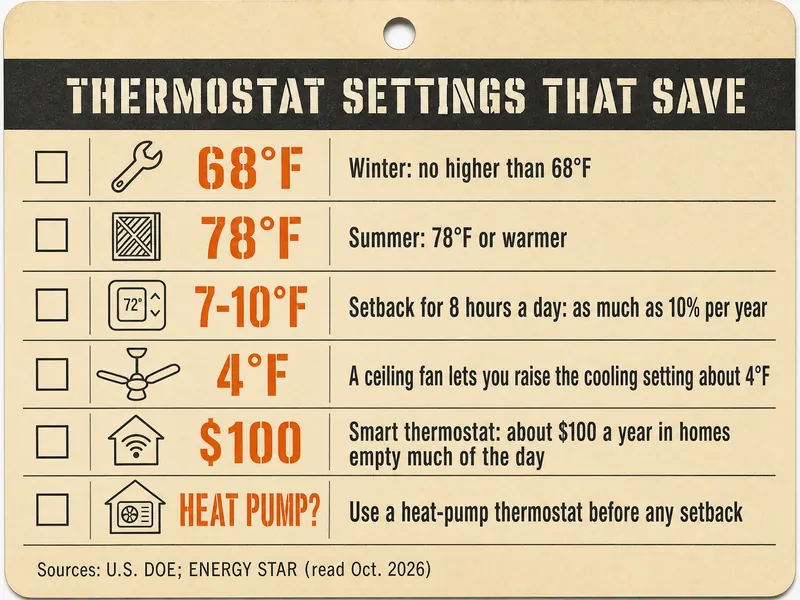
Thermostat settings that save money: DOE suggests no higher than 68°F in winter and 78°F or warmer in summer, plus a 7–10°F setback for 8 hours a day.
Penny Damper bench notes · updated
Partner links on this page go to PlumbingSupplyAndMore, under the same ownership as Penny Damper. They are there for price reference and examples; no figure here depends on them. How partner links work
Jump to a section
Shop notes
- DOE's targets: a winter setting no higher than 68°F, and a summer setting of 78°F or warmer (DOE webinar, 2015).
- Turning the thermostat down 7–10°F for 8 hours a day can save "as much as 10% per year" on heating and cooling, per DOE's 2022 Energy Saver Guide; heat pumps need a heat-pump thermostat before you try it.
- DOE says running the AC at 78°F instead of 72°F can save 6 to 18 percent on the cooling bill.
- A ceiling fan lets you raise the cooling setting about 4°F with no loss in comfort (DOE).
- ENERGY STAR puts smart thermostat savings at about $100 a year in homes that sit empty much of the day.
- Common non-Wi-Fi thermostats were listed at $30.44 to $91.34 (Wi-Fi models $75.89 to $279.00) at PlumbingSupplyAndMore on October 27, 2026, part only.
What is the best thermostat setting for winter?
For winter heating, DOE suggests no higher than 68°F, with a deeper setback when the house is empty or asleep. The line comes from a DOE, HUD and Education Department webinar: "In the winter, try not to set your thermostat higher than 68°F" (DOE webinar slides, Dec. 2015). That deck has a typo slide reading 68°C; the °F line is the one to use.
An older ENERGY STAR guide gives a fuller schedule: under 70°F at wake-up and in the evening, with a setback of at least 8°F during the day and overnight. Treat its numbers as a starting point, as the guide itself says, and nudge them until the household stops reaching for sweaters. Each degree you can live with lower is money kept.
| Time of day | Heating | Cooling |
|---|---|---|
| Wake | under 70°F | over 78°F |
| Day (house empty) | set back at least 8°F | set up at least 7°F |
| Evening | under 70°F | over 78°F |
| Sleep | set back at least 8°F | set up at least 4°F |
What is the best thermostat setting for summer?
For cooling, DOE suggests 78°F or warmer when you are home, and ENERGY STAR's room air conditioner page says the same: "Set the thermostat as high as is comfortable, typically 78° F" (ENERGY STAR).
DOE puts a range on it. Its summer savings article says "running your air conditioning at 78°F instead of 72°F can save between 6 and 18 percent on your cooling bill" (energy.gov, Top 11 Things, Summer Edition). The spread depends on climate and the house. On humid days, pair the higher setting with a ceiling fan rather than dropping the thermostat.
How much does a setback save?
DOE's figure is up to about a tenth of the heating and cooling bill: "You can save as much as 10% per year on heating and cooling by turning your thermostat down 7°–10°F for 8 hours a day in the fall and winter" (DOE Energy Saver Guide, 2022, p. 12). The easiest 8 hours are the ones you sleep through or spend at work.
The caveat matters. The same DOE page says, in parentheses: "If you have a heat pump, don't do this without a smart or programmable thermostat designed for use with heat pumps." A deep setback on a heat pump can bring on electric backup heat during recovery, which costs more; the full rules are on heat pump settings.
Thermostat numbers with their sources
- 68°Fwinter: no higher than thisDOE
- 78°Fsummer: this or warmerENERGY STAR
- 10%most a 7–10°F, 8-hour setback saves per yearDOE Energy Saver Guide
- 6–18%cooling saved at 78°F instead of 72°FDOE
- $100yearly smart thermostat savings in homes empty much of the dayENERGY STAR
To put dollars on it, ENERGY STAR's smart thermostat page says "almost half of the annual energy bill goes to heating and cooling – that's more than $900 a year." DOE's own guide puts the heating and cooling share lower, at about 32 percent of energy use, so the two agencies' figures should not be mixed. On a $900 heating and cooling spend, "as much as 10%" is up to about $90 a year (our arithmetic on ENERGY STAR's figure).
Does a programmable or smart thermostat pay off?
It pays when the house has a predictable empty stretch and nobody remembers to turn the dial by hand. ENERGY STAR says homes "that are unoccupied for much of the day, can save approximately $100 a year with an ENERGY STAR certified smart thermostat" (ENERGY STAR heating and cooling). It adds that certified models are judged on actual field data.
A programmable model does the same scheduling for less money. DOE's guide notes that programmable thermostats "need to be set up to turn the temperature up or down on a schedule ... but they are cheaper than smart thermostats." For price reference, common non-Wi-Fi thermostats, non-programmable to programmable, were listed at $30.44 to $91.34 (Wi-Fi models ran $75.89 to $279.00) at PlumbingSupplyAndMore on October 27, 2026, with a Honeywell T4 Pro programmable at $61.76 (part only). Penny Damper shares owners with that supply house.
Changing settings and batteries is homeowner work; replacing the thermostat means control wiring. DOE's guide suggests you install one or have a professional do it, and heat pumps, multi-stage systems and line-voltage baseboard heat are where a wrong wire costs money. Power off at the breaker before any cover comes off the wall. If you're unsure, call a licensed technician.
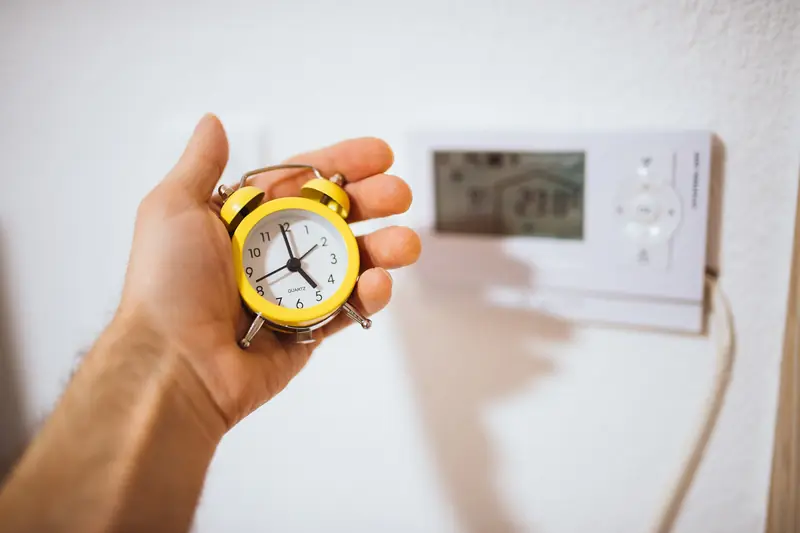
Placement and batteries count too. The 2009 ENERGY STAR guide says to install a thermostat "away from heating or cooling registers, appliances, lighting, doorways, fireplaces, skylights and windows," and to change batteries each year on battery models. A thermostat sitting in afternoon sun reads warm and runs the AC longer.
Do ceiling fans let you change the setting?
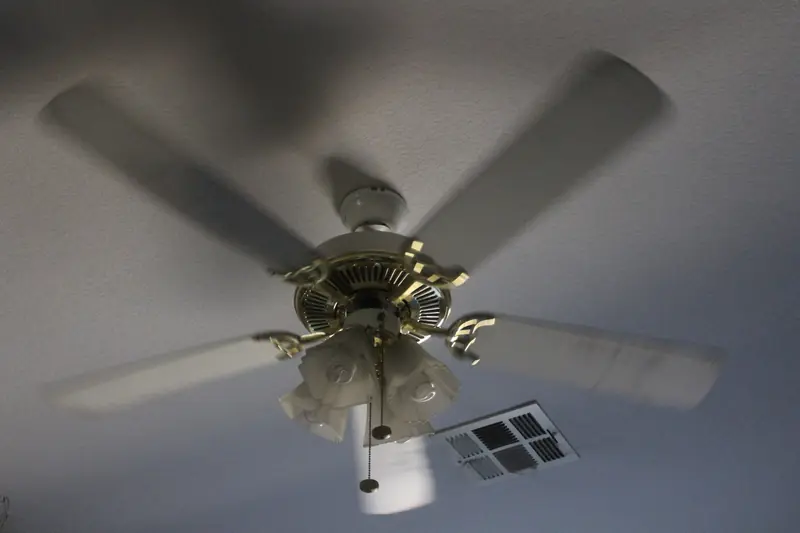
Yes, in summer, by about 4°F. DOE's guide says "using a ceiling fan allows you to turn up the thermostat about 4°F without any loss in comfort." Its summer article adds the reason: "fans cool people, not rooms," so switch the fan off when you leave the room.
In winter the fan does a different job. DOE says to "reverse the fan to run clockwise and force warm air down from the ceiling"; in summer it runs counterclockwise for a wind chill effect. DOE gives no winter setting change for fans, so don't count on one. The fan switch on the thermostat itself is separate: DOE says to set it to "Auto" unless an indoor air quality professional has set the system up to run the blower continuously.
Which settings changes cost money instead?
Cranking the thermostat far past the target does not heat or cool the house faster; it only overshoots. Closing registers in empty rooms is another trap: Lawrence Berkeley National Laboratory modeled California houses with ducts outside the living space and found it raised energy use (more on duct leaks). Heating one room with a plug-in heater has its own running-cost math and safety rules, covered on space heater safety.
Settings are only half the HVAC upkeep story. A clogged filter makes any setting cost more, which is why the MERV ratings page covers monthly checks.
How these numbers were checked
This page is based on DOE's Energy Saver Guide (2022 PDF), a DOE, HUD and Education Department webinar deck from December 2015, DOE's live "Top 11 Things You Didn't Know About Saving Energy at Home: Summer Edition" article, ENERGY STAR's heating and cooling, smart thermostat and room air conditioner pages, and an older ENERGY STAR heating and cooling guide (2009), all read October 27, 2026. Thermostat prices are PlumbingSupplyAndMore's listed prices on that date. Left out: DOE's retired Energy Saver web pages (offline), percentage savings for smart thermostats (ENERGY STAR gives dollars), and any claim about humidity letting you lower the heat.
More questions
Is 72°F a wasteful thermostat setting?
In summer, DOE's own comparison uses 72°F as the costly case: 78°F instead of 72°F can save 6 to 18 percent on cooling. In winter, 72°F is 4°F above DOE's suggested ceiling of 68°F. Comfort is personal, but each degree closer to those targets saves money.
Does turning the heat down at night make the furnace work harder in the morning?
DOE's guidance says the setback still saves: as much as 10% per year for 7–10°F over 8 hours. ENERGY STAR draws the line at heat pumps, which unlike a furnace or boiler do not save by being turned down. They need a heat-pump thermostat and shallow setbacks.
What temperature should the thermostat be set to on vacation?
No agency gives one vacation number. The ENERGY STAR schedule's daytime setback of at least 8°F in winter and setup of at least 7°F in summer is a sensible floor; go further if pipes are not at risk of freezing.
Should the thermostat fan be set to On or Auto?
DOE's guide says Auto, unless an indoor air quality professional set up the system to run the fan continuously.
Where should a thermostat not go?
The older ENERGY STAR guide lists registers, appliances, lighting, doorways, fireplaces, skylights and windows. Heat or drafts there make the thermostat misread the room. Moving a hard-wired thermostat is a job for an electrician or HVAC technician.
How often should thermostat batteries be changed?
ENERGY STAR's 2009 guide says once a year on battery-powered programmable models. A dead battery can blank the display and stop the system calling for heat, which looks like a broken furnace. Check it first on the furnace not working list.
Can a smart thermostat save money in a house where someone is home all day?
ENERGY STAR's $100 a year figure is for homes that sit empty much of the day. With someone home, the savings come mostly from overnight setbacks, which a cheaper programmable model can also do.
Next in safe upkeep