Space Heaters: Safety and Cost
Short answer
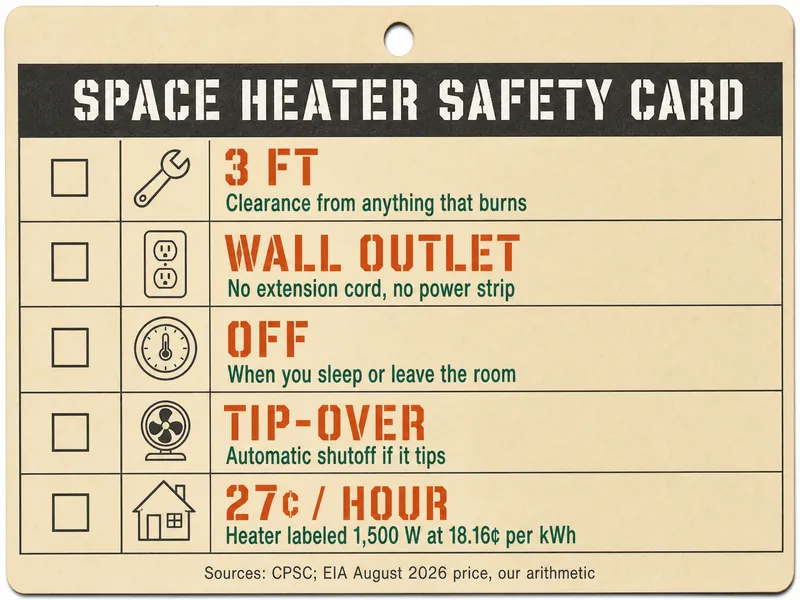
Space heater safety comes down to three CPSC rules: keep anything that burns 3 feet away, plug straight into a wall outlet, and turn it off when you leave or sleep. A 1,500-watt heater costs about 27¢ an hour.
Penny Damper bench notes · updated
Jump to a section
Shop notes
- CPSC says to keep beds, sofas, curtains, papers and clothes at least 3 feet from the front, sides and rear of a heater.
- Never power a heater with an extension cord or power strip, and never leave it running unattended or while you sleep, CPSC says.
- Portable heaters are involved in an average of 1,600 fires a year and caused an average of 70 deaths and 150 injuries a year from 2020 to 2022, per a January 2026 CPSC release.
- USFA says portable heaters were 3% of home heating fires in 2017–2019 but 41% of fatal heating fires.
- A heater labeled 1,500 watts costs about 27¢ an hour at EIA's August 2026 average of 18.16¢ per kWh.
- CPSC's 2011 safety checklist asks for thermostat control and an automatic shutoff if the heater tips over.
How do you use a space heater safely?
Give it room, give it a wall outlet, and never leave it on alone. CPSC's portable electric heater publication sets the distance: combustible material such as beds, sofas, curtains, papers and clothes at least 3 feet from the front, sides and rear. USFA uses the same 3 feet for anything that can burn near any heat source.
The cord and outlet are the next risk. CPSC says never to power a heater with an extension cord or power strip, never to run the cord under rugs or carpeting, and to check during use whether the plug, outlet or faceplate is hot. If one is, stop using the heater and have a qualified electrician check the outlet. Inspect the heater, cord and plug before each season, and don't use one you suspect is damaged.
Placement and attention finish the list. CPSC wants the heater on a stable, level surface where it won't be knocked over, away from water, and never touched with wet hands. Turn it off when you leave the room or go to bed; CPSC's 2025 winter flyer says do not leave it running unattended or while sleeping.
| Rule | Agency | Detail |
|---|---|---|
| 3 feet of clearance | CPSC, USFA | Front, sides and rear; beds, curtains, papers, clothes |
| Wall outlet only | CPSC | No extension cord, no power strip |
| Off when unattended or asleep | CPSC, USFA | Turn it off leaving the room or going to bed |
| Cord in the open | CPSC | Never under rugs or carpeting |
| Hot plug or outlet | CPSC | Stop using it; have an electrician check |
| Tip-over shutoff | CPSC (2011 checklist) | Heater turns off if it tips frontward or backward |
How much does a space heater cost to run?
Multiply the heater's kilowatts by your electricity price. A heater labeled 1,500 watts draws 1.5 kWh for each hour at full power, so at EIA's U.S. residential average for August 2026 of 18.16¢ per kWh it costs 1.5 × 18.16¢ ≈ 27¢ an hour. Four hours an evening is about $1.09, and 30 such evenings come to roughly $32.70.
A low setting changes the math only if it truly draws less. A heater whose label lists 750 watts on low would cost about 14¢ an hour at the same rate. Your own price may be well above or below the average, since state rates vary widely; check the per-kWh figure on your bill.
- 27¢per hour for a heater labeled 1,500 W at 18.16¢/kWhEIA (our arithmetic)
- 1,600average fires a year involving portable heatersCPSC
- 41%share of fatal home heating fires from portable heaters, 2017–2019USFA
- 3 feetclearance from anything that can burnCPSC
Does a space heater save money over central heat?
Only if the central thermostat comes down while the heater warms one room, and even then it depends on your fuel and rates. No live federal page we read gives a rule, so treat any "heat one room and save" claim as arithmetic you run yourself. The heater's cost is the easy half: about 27¢ an hour at 1,500 watts on the average price.
The other half is what the furnace or heat pump stops spending. DOE's Energy Saver Guide (2022) says turning the thermostat down 7–10°F for 8 hours a day can save as much as 10% per year on heating and cooling. If you have a heat pump, DOE adds, don't do this without a smart or programmable thermostat designed for heat pumps, because deep setbacks can bring on costly backup heat. ENERGY STAR says a heat pump can deliver up to three times more heat energy than the electricity it uses, so letting a resistance heater stand in for a heat pump deserves a careful look at the numbers. See heat pump settings and thermostat settings.
If the real problem is a bill you can't pay, the LIHEAP page covers state energy assistance.
Which space heater features matter?
Two features come straight from CPSC's checklist: a thermostat control and an automatic device that turns the heater off if it tips over frontward or backward. The same 2011 list warns children not to put fingers or objects through the protective guard, so a sturdy guard is worth checking too.
Beyond that, look for what keeps the cord and plug healthy: a cord long enough to reach the outlet without a power strip, and a plug that seats firmly. Skip any feature list that promises savings by itself; the watts on the label set the running cost.
Why should you never use a stove or grill for heat?
Because ovens, ranges and grills either aren't built to heat rooms or give off carbon monoxide indoors. USFA says never use an oven to heat your home. EPA says never use an electric or gas range or oven for heat, and not to heat with combustion appliances such as gas stoves, ovens or barbecue grills. CDC's carbon monoxide page says never heat your house with a gas oven.
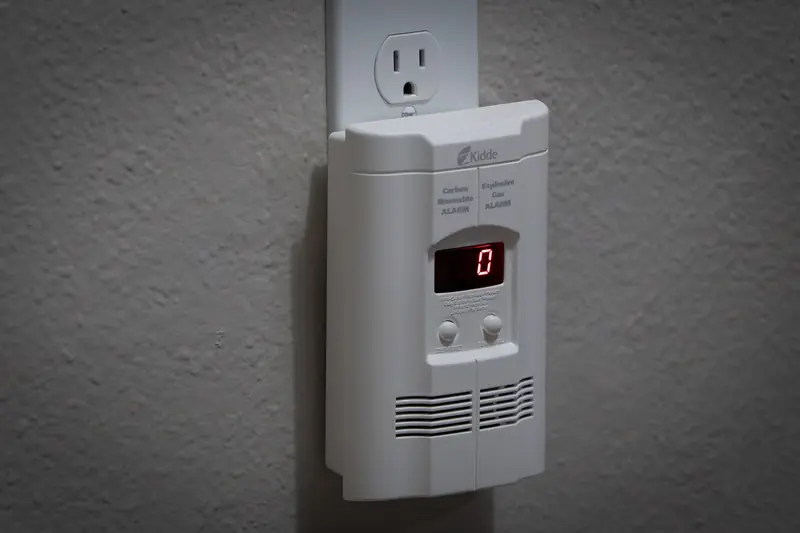
Generators belong outdoors only, at least 20 feet from the home, CPSC says; its January 2026 release counts about 750 generator CO deaths from 2012 to 2022. CPSC wants CO alarms on every level of the home; the carbon monoxide page covers placement and testing. If you smell gas, leave the house before calling 911 or the gas utility from outside. For a furnace that has quit, the furnace checks page lists what is safe to look at. If you're unsure, call a licensed technician.
How these numbers were checked
Based on CPSC's portable electric heater publication, its 2011 safety checklist, 2025 winter flyer and January 2026 winter safety release; USFA's heating-fire page and heating flyer; EPA's winter indoor air page; CDC's carbon monoxide page; DOE's Energy Saver Guide (2022); ENERGY STAR's heat pump page; and EIA's August 2026 electricity prices, read in October 2026. Cost figures are our own arithmetic on label wattages. Left out: NFPA statistics (the page would not load), any claim that space heaters save money in general, and "overheat protection" as an agency recommendation.
More questions
Can I plug a space heater into a power strip if it's heavy-duty?
CPSC says never to power a heater with an extension cord or power strip, with no heavy-duty exception in its current advice. Plug it directly into a wall outlet, and stop using it if the plug or outlet gets hot.
Is it safe to run a space heater overnight in a bedroom?
CPSC says not to leave a heater running while you sleep, and USFA says to turn it off when going to bed. Warm the room before bed, then switch it off.
How much does a space heater add to the electric bill?
Multiply the kilowatts on the label by hours of use and your price per kWh. A heater labeled 1,500 watts at 18.16¢ costs about 27¢ an hour, so four hours a night for 30 nights is roughly $32.70.
Are space heaters safe in a bathroom?
CPSC's checklist urges special caution with electric heaters in bathrooms, since moisture and contact with water or grounded fixtures can cause shocks. Keep any heater away from water and never touch one with wet hands.
How far should a heater be from a bed or couch?
At least 3 feet from the front, sides and rear, according to CPSC. That distance also applies to curtains, papers and clothes.
Can I use a gas oven to heat the kitchen for a few minutes?
No. USFA, EPA and CDC all say never to use an oven to heat a home, and a gas oven used that way can raise carbon monoxide levels.
Keep reading