Repair or Replace? A Simple Cost Test
Short answer
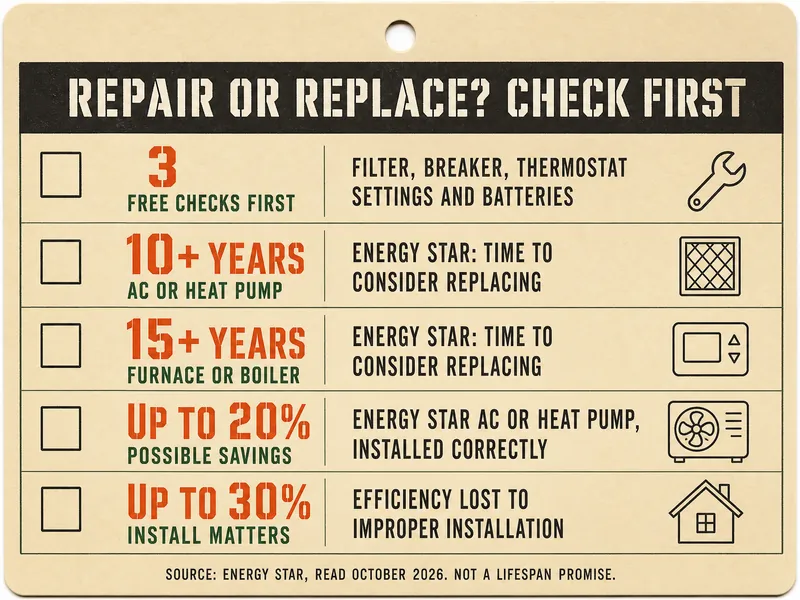
Repair or replace starts with three free checks (filter, breaker, thermostat), then weighs age, the repair quote and safety; ENERGY STAR suggests considering replacement past 10 years for an AC, 15 for a furnace.
Penny Damper bench notes · updated
Partner links on this page go to Central Plumbing HVAC, PlumbingSupplyAndMore, under the same ownership as Penny Damper. They are there for price reference and examples; no figure here depends on them. How partner links work
Jump to a section
Shop notes
- Check the filter, the breaker and the thermostat before anyone quotes a repair; Lennox lists these same checks for owners to do before calling.
- ENERGY STAR says to consider replacing a heat pump or AC more than 10 years old, or a furnace or boiler more than 15 years old.
- Heating and cooling is "nearly half" of the energy used in a home, per ENERGY STAR, so the efficiency of the equipment shows up on every bill.
- Certified AC and heat pumps installed correctly "can save up to 20 percent" on heating and cooling costs (ENERGY STAR); a bad install can cost up to 30 percent of efficiency.
- The "$5,000 rule" (age times repair cost) is a trade rule of thumb with no official source behind it.
- Safety overrides the math: a cracked heat exchanger, a gas smell or a sounding CO alarm is not a repair-versus-replace question.
When should you repair or replace an AC or furnace?
Repair when the system is younger than ENERGY STAR's age signals and the fault is a single part; start pricing a replacement when it is past them and the repair is large. Before either, rule out the cheap causes, because a surprising share of "dead" systems are a setting, a switch or a filter.
Run these checks with the thermostat set to Off first:
- Thermostat. Confirm it is on Heat or Cool and set past the room temperature. Carrier notes battery thermostats may simply need new batteries. Common non-Wi-Fi thermostats were listed at $30.44 to $91.34, part only, at PlumbingSupplyAndMore (same owners as this site) on October 27, 2026.
- Power. Check that the furnace switch (it looks like a light switch on or near the unit) and the outdoor disconnect are on. Reset a tripped breaker once. Carrier says that if it trips right after resetting, "do not try again"; that's a call for a technician.
- Filter. Pull it and look. A clogged one can shut a furnace down on its safety limit or freeze an AC coil. Pleated 1-inch MERV 8 filters were listed at $5.22 to $14.17, part only, on the same date; see which filter to buy.
If all three are fine, the problem is inside the equipment; see the furnace not working and AC not cooling pages. Anything past these checks is a licensed technician's work. If you're unsure, call a licensed technician.
How long do systems usually last before you replace them?
No federal agency publishes a lifespan you can plan around; the figures out there come from makers. Carrier's lifespan page lists 15 to 20 years for a furnace or an air conditioner and 10 to 15 years for a heat pump or ductless mini split. Lennox gives central air conditioners 15 to 20 years.
Treat those as one maker's estimates. ENERGY STAR's 10-year and 15-year marks are the ages to start comparing, not a forecast of failure.
| Equipment | ENERGY STAR: consider replacing when older than | Carrier's typical life |
|---|---|---|
| Central air conditioner | 10 years | 15–20 years |
| Heat pump | 10 years | 10–15 years |
| Gas furnace | 15 years | 15–20 years |
| Boiler | 15 years | Not listed |
| Ductless mini split | Not listed | 10–15 years |
What is the repair-cost rule of thumb?
The best-known one multiplies the system's age in years by the repair quote in dollars; if the product passes 5,000, the rule says lean toward replacing. This so-called $5,000 rule is a trade rule of thumb, not an official standard, and no agency backs it.
Run it backward to find your line: divide 5,000 by the age. For a 12-year-old system that is about $417; for a 20-year-old furnace it is $250. A quote above that line is the point to ask for a replacement price too, not an order to replace.
The rule misses three things that matter more. The kind of repair matters: a capacitor on an 11-year-old AC is a small part ($8.96 to $19.21, part only, listed at PlumbingSupplyAndMore on October 27, 2026), while a compressor is close to a new outdoor unit (see what a compressor job involves). The refrigerant matters: an R-410A system can still be repaired, but EPA expects refrigerant prices "may rise," covered on the refrigerant leaks page. And labor matters: the BLS median pay for HVAC mechanics was $29.33 an hour in May 2025, and a company's rate adds its truck, insurance and overhead, so get the diagnosis and the itemized quote in writing.
Repair-or-replace numbers
- 10 yearsAge when ENERGY STAR suggests considering a new AC or heat pumpENERGY STAR
- 15 yearsAge when ENERGY STAR suggests considering a new furnace or boilerENERGY STAR
- 52%Share of household energy for space heating and AC, 2020EIA
- Up to 20%Heating and cooling savings from certified AC or heat pumps installed correctlyENERGY STAR
- Up to 30%Efficiency lost to improper installationENERGY STAR
How much can a more efficient system save?
ENERGY STAR says certified central AC and heat pumps "can save up to 20 percent on heating and cooling costs" when installed correctly. Its certified furnaces are 15 percent more efficient than conventional ones. The U.S. Department of Energy's Energy Saver Guide (2022) says new equipment alone can cut energy use by 20 percent or more, and adding insulation, air sealing and good thermostat settings can cut heating and cooling bills by about 30 percent.
Those savings land on a big slice of the bill. The EIA found space heating and air conditioning were 52 percent of household energy use in 2020. For the cooling numbers by region, the SEER2 page works through DOE's own examples.
What should a replacement quote include?
A good quote names the exact equipment and shows the work in lines you can compare. Ask for:
- Model numbers for the outdoor unit, indoor coil and furnace or air handler, with their SEER2 and HSPF2 ratings, and confirmation they meet the regional minimum.
- The refrigerant. EPA rules effective July 27, 2026 still allow R-410A systems made before 2025 to be installed, as of October 2026, but new designs use A2L refrigerants; ask which you are getting and why.
- Whether both the outdoor unit and indoor coil are replaced. EPA's frequent questions treat replacing both as a new system.
- Duct work, old-unit removal, warranty terms and the payment schedule.
To see how equipment is listed for sale, PlumbingSupplyAndMore's unitary HVAC equipment listings (PlumbingSupplyAndMore, under the same ownership as Penny Damper) and mini split listings show model types and specs; Penny Damper shares owners with that supply house, and installing any of it is a licensed contractor's job. For what a local company's service page covers, Central Plumbing HVAC's air conditioning page (Central Plumbing HVAC, under the same ownership as Penny Damper) is one example; it works in Bucks and Montgomery County, Pennsylvania, so if you live elsewhere, look for a licensed company near you.
Before you sign, read the financing red flags. A sale made in your home is covered by the FTC's three-day Cooling-Off Rule (16 CFR 429) when it is $25 or more, but a repair visit you asked for is not, though extra items sold during it are.
When does safety decide it?
Some findings end the cost debate. The ENERGY STAR maintenance checklist warns that a dirty burner or cracked heat exchanger causes improper burner operation, and that either can make equipment run less safely. Ask to see the finding and get it in writing.
If you smell gas, leave the house first, don't touch switches or phones inside, and call 911 or the gas utility from outside. If a CO alarm sounds, get outside to fresh air, then call 911 or the fire department. The CPSC recommends a professional inspection of fuel-burning heating equipment every year, and the carbon monoxide page covers alarm placement. If you're unsure, call a licensed technician.
How these numbers were checked
Based on ENERGY STAR's replacement, heating and cooling, and maintenance pages; the DOE Energy Saver Guide (2022); EIA home energy data (2020); Carrier and Lennox lifespan pages and manual; EPA's HFC frequent questions; 16 CFR 429; CPSC's January 2026 release; and BLS pay data (May 2025). Part prices are PlumbingSupplyAndMore's listed prices on October 27, 2026, part only. All sources read October 27, 2026. Left out: labor and installed-system prices, lifespans stated as fact, and savings claims larger than the ENERGY STAR and DOE figures above.
More questions
Is a 15-year-old air conditioner worth repairing?
It can be for a small, single-part repair. At 15 it is past ENERGY STAR's 10-year mark, so for anything large, get a replacement quote alongside the repair quote and compare.
Should I replace the furnace and AC at the same time?
Not always, but it is worth pricing both when one fails and the other is near its age mark. Ask for one quote that prices them together and separately, so you can see what the combined job really saves.
Does a new system fix high bills on its own?
Not always. ENERGY STAR says to address big air leaks in the house and ducts first, and the DOE guide says equipment plus insulation, air sealing and thermostat settings together can cut heating and cooling bills by about 30 percent.
Can I still claim a tax credit on a replacement?
Not for equipment installed in 2026. As of October 2026, the IRS says the 25C and 25D credits don't apply to property placed in service after Dec. 31, 2025. The tax credits page covers the rebates that remain.
What does the "check first" line on the home page mean?
It points to the three free checks at the top of this page: filter, breaker and thermostat. They take minutes.
Is a heat pump a sensible replacement for an old AC?
It can be, since it heats and cools; heat pump settings explains how to run one cheaply. Ask the contractor to size it for your house and to show the SEER2 and HSPF2 ratings in the quote.
Related pages