HVAC Tax Credits and Rebates in 2026
Short answer
HVAC tax credits under 25C and 25D ended for equipment installed after Dec. 31, 2025; as of October 2026, the help left is state-run HOMES and HEEHR rebates, utility rebates and income-based programs.
Penny Damper bench notes · updated
Jump to a section
Shop notes
- As of October 2026, the IRS says the 25C credit is not allowed for property placed in service after Dec. 31, 2025, and 25D ends for expenditures after that date (IRS FS-2025-05).
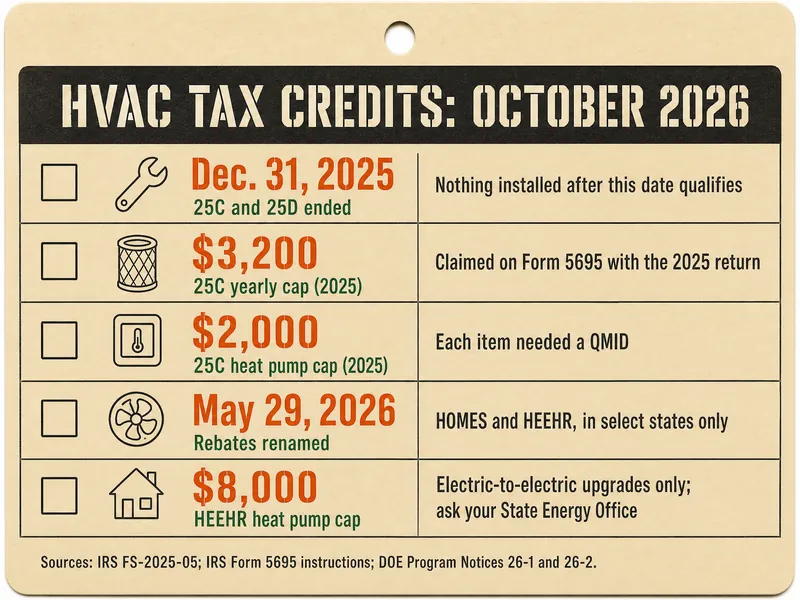
- For 2025 installs, 25C was capped at $3,200 a year, with $2,000 for heat pumps and $600 per central AC or furnace; you claim it on Form 5695 with your 2025 return.
- Each 2025 item needs its maker's four-character QMID on the return (Form 5695 instructions).
- DOE renamed the IRA rebates HOMES and HEEHR on May 29, 2026; they run only in "select states."
- HEEHR pays up to $8,000 toward a heat pump, but since May 29, 2026 only when replacing electric equipment, not gas, oil or propane.
- The ENERGY STAR Rebate Finder searches utility and maker offers by ZIP code.
Can you still claim the 25C credit for a heat pump?
Only if the heat pump was installed by the end of 2025. As of October 2026, the IRS says the Energy Efficient Home Improvement Credit (25C) "will not be allowed for any property placed in service after December 31, 2025," following Public Law 119-21, signed July 4, 2025. A heat pump installed in 2026 gets no federal credit, even if you paid a deposit in 2025.
If yours went in during 2025, the credit still matters for your 2025 return. The IRS 25C page set it at 30 percent of qualified costs, up to $3,200 a year: $2,000 for qualified heat pumps, and $1,200 for everything else, with central air conditioners and gas, propane or oil furnaces capped at $600 per item and a home energy audit at $150. Equipment had to meet the Consortium for Energy Efficiency's highest tier (not counting an advanced tier).
Three filing details trip people up. You claim the credit for the year the equipment was installed, not bought. You file Form 5695, Part II, and the 2025 instructions require "the four-character alphanumeric unique qualified manufacturer identification number (QMID) for each item," so get it from the contractor or the maker. And the credit is nonrefundable with no carryforward; the IRS says "You can't apply any excess credit to future tax years."
Credits and rebates, as of October 2026
What happened to the 25D credit?
It ended at the same time. The Residential Clean Energy Credit (25D), which covered geothermal heat pumps (not air-source ones) at 30 percent, among other items, does not apply to expenditures after Dec. 31, 2025. The IRS adds that for 25D "if installation is completed after December 31, 2025," the cost counts as made after that date, so paying in 2025 for a 2026 install doesn't qualify.
The IRS 25D page still carries an older line about a phase-out in later years; the same page and the IRS FAQ say the credit is over for property placed in service after 2025. Go by the FAQ and the Form 5695 instructions.
| Program | What it covered | Status | Where to check |
|---|---|---|---|
| 25C Energy Efficient Home Improvement Credit | Heat pumps, central AC, furnaces, boilers, audits | Ended for property placed in service after Dec. 31, 2025 | IRS, Form 5695 |
| 25D Residential Clean Energy Credit | Geothermal heat pumps, among other items | Ended for expenditures after Dec. 31, 2025 | IRS, Form 5695 |
| HOMES (Home Owner Managing Energy Savings) | Whole-home upgrades with modeled savings of 20%+ | Live in select states | State Energy Office |
| HEEHR (High-Efficiency Electric Home Rebates) | Heat pumps and electric upgrades; HVAC and appliance swaps must be electric-to-electric | Live in select states | State Energy Office |
What are the home energy rebate programs?
They are two DOE-funded, state-run programs: HOMES, which pays by modeled whole-home energy savings, and HEEHR, which pays set amounts for electric equipment. DOE's Home Energy Rebates page says they are "now available in select states" and tells you to contact your State or Territory Energy Office. DOE publishes no current list of which states have launched.
Both names changed on May 29, 2026. Under Program Notice 26-2, the program once called "Home Electrification and Appliance Rebates" (HEAR) was renamed High-Efficiency Electric Home Rebates (HEEHR), and Program Notice 26-1 renamed Home Efficiency Rebates to HOMES. The bigger change: HEEHR now allows HVAC and appliance rebates "only from existing electric equipment to more efficient electric equipment," so a gas, oil or propane furnace swapped for a heat pump no longer qualifies. Homes also need insulation and air sealing first unless they are already insulated well enough.
The money depends on income against area median income (AMI). DOE's program requirements cap a HEEHR heat pump at $8,000 and pay 100 percent of the qualified cost below 80 percent of AMI, or 50 percent between 80 and 150 percent. For a single-family home with 35 percent modeled savings, HOMES pays households under 80 percent of AMI the lesser of $8,000 or 80 percent of the cost. Program Notice 26-2 says a HEEHR rebate can't be combined with another federal grant or rebate for the same project.
Which utility rebates are worth asking for?
Ask your electric and gas utility first, because their rebates are set locally and don't depend on the federal credits that ended. The ENERGY STAR Rebate Finder lets you "find rebates and special offers near you on ENERGY STAR certified products" by entering a ZIP code; its heating and cooling categories include air-source heat pumps, furnaces, boilers and smart thermostats.
The rebates worth the phone call are the ones tied to things you'd buy anyway: a smart thermostat (ENERGY STAR puts its savings at about $100 a year in homes empty much of the day), a heat pump replacing electric resistance heat, or duct sealing. Get the rebate terms in writing before the install, including who files the paperwork and whether the contractor must be on an approved list.
If money is the obstacle, the income-based programs often pay more than any rebate. The Weatherization Assistance Program says households save "on average $372 or more every year," and LIHEAP can help with bills and minor energy-related home repairs. Start with LIHEAP and weatherization, or the full list on bill help.
How do you check a contractor's rebate claims?
Ask for the program's name, the dollar amount, and who confirmed it, then check it yourself before signing. Any of these is a reason to slow down:
- "Federal tax credit" on 2026 work. The IRS says neither 25C nor 25D applies to anything placed in service after 2025.
- A HEEHR rebate for replacing a gas furnace. Since May 29, 2026, HEEHR pays for heating equipment only when it replaces electric equipment.
- A rebate "in every state." DOE says the rebates are in select states; your State Energy Office can confirm.
- Rebate math that assumes 100 percent. That share is for HEEHR households under 80 percent of AMI; others get 50 percent, and HOMES pays by modeled savings.
- A QPIN label as proof. The IRS FAQ says manufacturer reporting is no longer required because the credit ended.
The FTC's advice on home improvement scams applies here too: don't pay the full amount up front, and don't take contractor financing without comparing terms, covered on the financing red flags page. Before choosing equipment at all, run the repair or replace test.
How these numbers were checked
Based on IRS FS-2025-05 (Aug. 21, 2025), the IRS 25C, 25D and qualified-manufacturer pages, the 2025 Form 5695 instructions, DOE's Home Energy Rebates page, Program Notices 26-1 and 26-2 (effective May 29, 2026), DOE's program requirements (Dec. 16, 2024), the ENERGY STAR Rebate Finder and heating and cooling pages, DOE's weatherization page, ACF's LIHEAP page and the FTC's home improvement advice, all read October 27, 2026. This is general information, not tax advice. Left out: a list of states with live rebates (DOE doesn't publish one), state and utility rebate amounts, and the old 2033 end date.
More questions
My heat pump was installed in December 2025. Can I still claim 25C?
Yes, on your 2025 return, if it met the efficiency requirement and you have the maker's QMID. The IRS says property placed in service after Dec. 31, 2025 is barred, so a Dec. 31 install still counts.
Does a 2025 deposit count if the install happened in 2026?
No. The IRS says you claim 25C for the year the property is installed, not bought, and for 25D an installation completed after Dec. 31, 2025 is treated as a 2026 expenditure.
Is HEAR still a program, or was it renamed?
It was renamed: DOE changed it to High-Efficiency Electric Home Rebates (HEEHR) effective May 29, 2026, and limited its HVAC and appliance rebates to electric-to-electric upgrades.
Are rebates taxable income?
The IRS 25C page points readers to IRS Announcement 2024-19 for the tax treatment of DOE Home Energy Rebates. Ask a tax preparer how it applies to your return.
Can renters use these programs?
Weatherization is open to both homeowners and renters, according to DOE. Rebate rules for rental units are set by each state program, so ask the State Energy Office.
Do I need an energy audit to get a HOMES rebate?
HOMES pays based on modeled energy savings of at least 20 percent, so the state program will need a model of your home's use. Ask the State Energy Office how its program does the modeling.
Related pages